Further to my earlier pictures, I see that plaques put in place on July 13 may be covered and unveiled by the mayor on July 23:
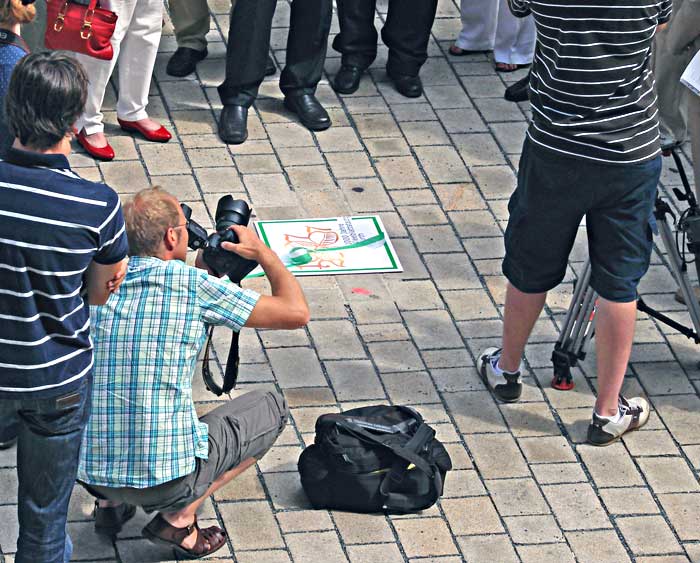
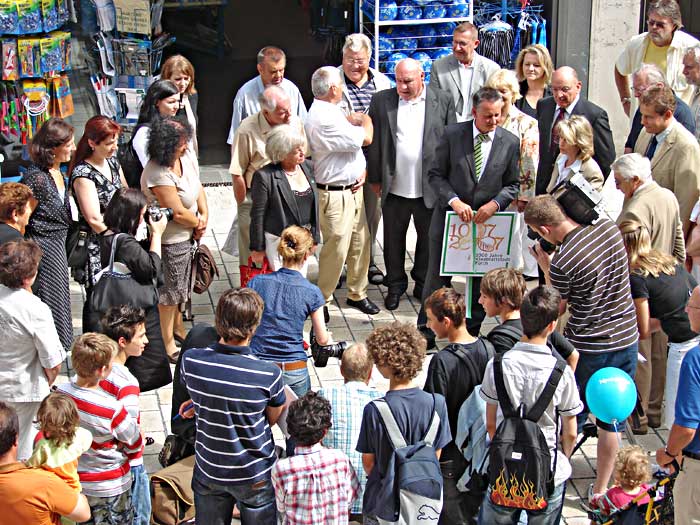
I should spend more time hanging out of the window.

Further to my earlier pictures, I see that plaques put in place on July 13 may be covered and unveiled by the mayor on July 23:
I should spend more time hanging out of the window.
Drei Möwenküken auf dem Dach eines Gebäudes in Bournemouth, an der englischen Südküste, wurden auf Veranlassung von einer Anwaltskanzlei von Schädlingsbekämpfern getötet, zum Leidwesen vieler Zuschauer, u.a. aus einer anderen Kanzlei.
Under the heading Gulls ‘Strangled’ In Front Of Staff, the Bournemouth Daily Echo reports:
STAFF at offices in Bournemouth were left horrified and in tears after watching three seagull chicks killed in front of them because they were deemed a health and safety risk.
The seagull family lived on the roof of Harold G Walker solicitors in Oxford Road, Bournemouth, and the young chicks had become favourites among staff in surrounding buildings.
Apparently members of the Crown Prosecution Service were watching too.
The story was also taken up by the Law Society Gazette and RollOnFriday (the latter writes ‘No-one mention the hawk in Broadgate’, but that would be the perfect antidote, of course).
The commenters on the Daily Echo are incensed and will not use the services of Harold G Walker in future. One writes (my emphasis):
What Harold Walker has failed to grasp is the impact on the people who have witnessed this incident as it was carried out in an unprofessional manner. ProKill are incorrest to quote that they followed the guidelines as I would like to know where DEFRA state that you are allowed to stamp on a birds head. I would like to add that we are not talking once ,but for several moments so death did not come quickly to the creature, and to add insult to injury to wave at the staff who had come out of their offices in shock is just unbelievable.
There is a certain escalation in the comments.
Sasha Volokh had a query about the meaning of a Dürrenmatt sentence, or rather part of one, yesterday (the Ed. of Blawgreview alerted me to it) – I’ve indicated the problem part in bold:
[A]uch ich habe eine Kunsttheorie, was macht einem nicht alles Spaß, doch halte ich sie als meine private Meinung zurück (ich müßte mich sonst gar nach ihr richten) und gelte lieber als ein etwas verwirrter Naturbursche mit mangelndem Formwillen.
It looks as if Sasha suspected the correct meaning, which was different from a published translation. I think the exchange is a good example of the difficulty of talking about language and translation. Some people seem to have no awareness of how slight their grasp of grammar is, though.
I haven’t got the TLS for this week yet, but one article is online: a review by Adrian Tarhourdin of a book by a French professor of literature and psychoanalyst on how to talk about books one has not read:
Pierre Bayard
Comment parler des livres que l’on n’a pas lus?
162pp. Minuit. 15euros. 978 2 7073 1982 1
Bayard finds three constraints shaming us: the need to read, the need to read something to the bitter end, and the need to read a book if we are to talk about it.
[Bayard] divides the works he mentions into four categories: LI indicates livres inconnus (books he is unfamiliar with); LP livres parcourus (books glanced at); LE livres dont jai entendu parler (books he has heard discussed) and LO les livres que jai oubliés (books he has read but forgotten). Ulysses, for example, falls into the category LE: he claims not to have read the novel, but he can place it within its literary context, knows that it is in a sense a reprise of the Odyssey, that it follows the ebb and flow of consciousness, and that it takes place in Dublin over the course of a single day. When teaching he makes frequent and unflinching references to Joyce.
Here’s a quote from Bayard himself:
“in order to . . . talk without shame about books we havent read, we should rid ourselves of the oppressive image of a flawless cultural grounding, transmitted and imposed [on us] by the family and by educational institutions, an image which we try all our lives in vain to match up to. For truth in the eyes of others matters less than being true to ourselves, and this truth is only accessible to those who liberate themselves from the constraining need to appear cultured, which both tyrannizes us and prevents us from being ourselves.”
Like Bayard at one point in the article, I am not sure how blatant one should be about ignorance. For instance, I once spent some time around a dinner table where another guest spent some time discussing how bad the Harry Potter novels (as it happens) are, but she hadn’t read any of them herself.
…jurabilis! links to the weblog of a German law student who is spending part of his trainee period in Auckland, New Zealand. downwärts , subtitled seb goes to kiwihausen has been running since May. Amusing details of adjusting to life in NZ (including a photo of the water in a washbasin swirling anti-clockwise) and choice details on law courses.
* Beim Aussteigen aus dem Bus bedanken sich fast alle beim Fahrer. Sehr putzig.
* Die niedrigste Münze hat hier den Wert von 10 cent. D.h. Preise werden an der Kasse gerundet oder im Voraus nicht kleiner als 10 cent angegeben.
* Es gibt hier keine Tiefkühlpizza ohne Fleisch!
The Times online (via Boing Boing) reports that it may be possible to trace the person who leaked the Harry Potter book in photos on the Web yesterday (the publisher, Bloomsbury, won’t confirm that this was genuine, presumably as a damage limitation exercise). The serial number of the camera is part of the EXIF data, and if the camera, an early Digital Rebel, has been repaired or registered, the number will be linked to a name.
However, there would probably be no criminal charges, as there was no commercial gain. Civil damages would be based on the loss in book sales.
If traced, the person who photographed the Harry Potter novel could be found guilty of copyright infringement, but would be unlikely to face criminal charges as the photos appear not to have been published for commercial gain, lawyers said.
“There are criminal provisions in copyright legislation, but they tend to be used in cases of obvious counterfeiting – such as selling fake computer games or DVDs in a car boot sale,” Mark Owen, an intellectual property partner at the London firm Harbottle & Lewis, said. “If Bloomsbury were to pursue an action, it would more likely be a civil case, in which case any damages would be assessed according to the loss in book sales.”
The Times calls the EXIF numbers ‘digital DNA’!
Some EXIF data (bottom left) from a Sony DSC-H5 (click to enlarge).
