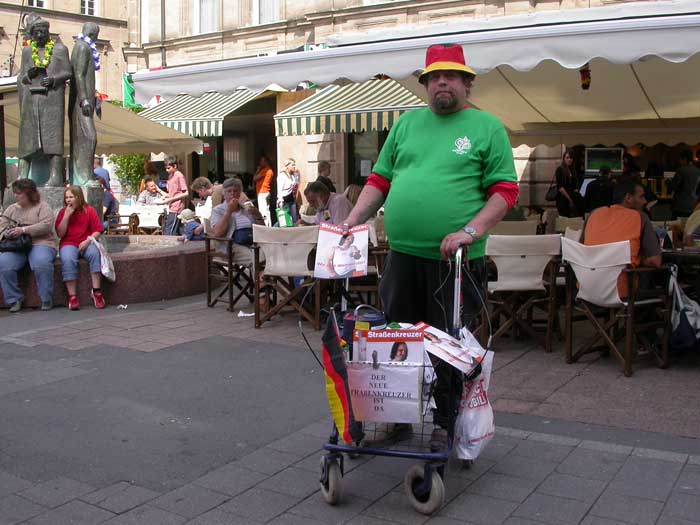
Problem bear in Bavaria / Problembär, Schadbär, Risikobär

The term ‘problem bear’ seems to be used in English too. The bear whose recent movements have been Bavaria – Austria – Bavaria is apparently called Bruno (or JJ1) and has killed twenty sheep since the beginning of May – most bears only kill two sheep a year. He is said to come from a problem family.

At all events, Jurabilis (which has the text of Stoiber on the subject – surely this man has a future in stand-up comedy?) claims that you can increase your website’s hits if you merely mention the bear – as Elbeblawg did when it linked to the audio file of Stoiber. So let’s see. But maybe it only works for German-language blogs.

bq. Nun haben wir, der normal verhaltende Bär lebt im Wald, geht niemals raus und reißt vielleicht ein bis zwei Schafe im Jahr. Äh, wir haben dann einen Unterschied zwischen dem normal sich verhaltenden Bären, dem Schadbär und dem Problembär. Und, äh, es ist ganz klar, dass, äh, dieser Bär, äh, ein Problembär ist und es ist im Übrigen auch, im Grunde genommen, durchaus ein gewisses Glück gewesen, er hat um 1 Uhr nachts praktisch diese Hühner gerissen.

What I want to know is, what happened to the greatly misnamed Carl Gustav, the elk that has been spending quite some time in Bavaria?

Bill translated into plain English / Gesetzesentwurf aus der Amtssprache übersetzt

The British government wants to reform the coroner system and a bill is to be published next Monday ( June 12). From what the Times Online says, it’s going to be accompanied by a translation into plain English.

bq. The Coroner Reform Draft Bill, published on Monday, will make legal history with an easy-to-understand interpretation of every clause running alongside the text. The simultaneous translation was requested by Harriet Harman, Constitutional Affairs Minister, who said that it was time that the public could read the laws passed in their name.
“Many ministers, let alone MPs, find Bills in the current form hard going, so I don’t know how on earth the public is expected to understand them,” she said.

The trouble with this kind of thing is that probably not everything can be said in plain English. But the draughtsmen are said to be ‘thrilled’ with their translation, and in addition to being easier to read, it also explains all the cross-references.

This could be very useful for translators who work out of English.

There was a session on plain English at Düsseldorf, and I was gradually working up to blogging it, but it’s a complex topic. So here are a few notes:

Andrew Hammel (who has been blogging on the same topics as me) presented an interesting paper on translating into plain legal English. The suggestions seemed radical to me, but the example he gave of one long sentence and a plainer version seemed less radical.

bq. When you must translate such “convoluted and repetitious prose,” are you
permitted to make it simpler and more elegant? Split up 8-line sentences? Untangle nests of relative clauses? Strip needless jargon? The issue presents a host of practical and theoretical problems for the translator. In this paper, I will suggest that the audience for the particular translation usually determines the approach to be used.

This is obviously a question of degree – how far might one go? I recently nearly got a job that involved translating a conveyancing agreement for an American who was selling a house here, and for whom the translation needed to be explanatory. Of course, a real explanatory text would have been much longer and taken longer to do, and it would have approached unauthorized practice of law and needed some disclaimers in any case. So when discussing this topic, examples are essential.

Books on plain English for lawyers are also useful when they indicate which archaic terms are terms of art and which are not. The same goes for doublets and triplets. If Mellinkoff says that two words are synonyms, we can probably rely on it and don’t need to find two German equivalents.

‘Plain English’ is a wide field, though. It was necessary for the linguists (the American term usually refers to scholars of linguistics) to exchange doleful mutterings about the Plain English movement (‘we don’t need to avoid passive constructions all the time’ etc. – I agree with them) in order to feel comfortable with the topic.

There was a paper by Khanh-Duc Kuttig on plain language, which went through the basics and then illustrated by an example how plain English documents can be difficult to understand themselves. A slightly altered version of that document is here (INF 1 on the UK visas site).

There was an interesting paper by Janet Giltrow on direct and indirect speech in judgments, showing how complex the two are (judges reporting direct speech attributed to several speakers at once, indirect speech missing the tone of voice, citation of authorities conveying a sense of authenticity versus citation of non-authorities carrying a question mark). This moved away from the topic of plain English, via a consideration of how much goes on in legal texts.

Überbee

CNN reports:

A 13-year-old New Jersey girl making her fifth straight appearance at the Scripps National Spelling Bee rattled off “ursprache” to claim the title of America’s best speller on prime-time television Thursday night.

Katherine Close ‘recognized the word as soon as she heard it’:

“I’m just in shock,” Katharine said. Asked what she’ll remember most, she said: “Probably just hearing ‘ursprache,’ which is a parent language.”

I wonder how they pronounced it. The runner-up was probably named to be a speller:

Runner-up was Finola Mei Hwa Hackett, a 14-year-old Canadian, a confident speller during two days of competition who stumbled on “weltschmerz,” which means sadness over the evils of the world.

I believe spelling bees are creeping into Britain. Here is a Guardian (sic) spelling quiz.

(Via Wordlab – thanks to Abnu)

Athlete’s foot / Fußpilz

I used to think the German term Fußpilz (Pilze are mushrooms and toadstools or moulds) had nothing to do with athletes, but the local pharmacist’s window suggests otherwise:

athlw.jpg

And on the same topic, I think Ikea ordered these quite some months ago – well, that explains the Turkish flag, but not the Union Flag:

elchw.jpg