Alaaf – Helau – carnival language

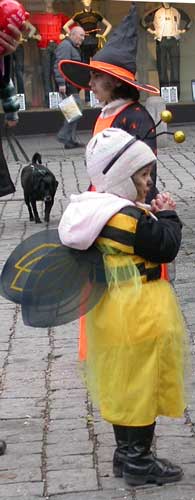
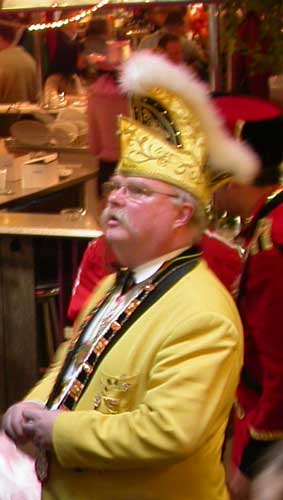
Philip Lenssen, a German contributor to the group blog Google Blogoscoped, has used Google to collect a list of 200 German towns and what words are used as a carnival salute (Alaaf or Helau) and for carnival (Fasching or Karneval – the word Fastnacht, Fasnet etc. isn’t even considered).

bq. I can’t say this strikes me as very authoritative. Incidentally, I heard a Fasching event about ten days ago where the cry was ‘Fürth Alaaf – Franken Helau’.
The Googleshare algorithm here is simple enough. Let’s take Hamburg as example. If the page-count for the Google result for Hamburg Helau is higher than for Hamburg Alaaf, it will assume “Helau” is indeed the way to salute during carnival in Hamburg. As most automated data mining with Google, this algorithm isn’t failsafe; in particular, it disregards the fact some of the cities do not have carnival in he first place.

Duden says Alaaf is from Cologne and from ‘alles ab’ meaning ‘alles (andere) weg’ (Kluge’s etymological dictionary agrees, saying it is a call for more space), and Helau means Hurrah.

(Via Handakte WebLAWg)
Portuguese legal weblogs

From my referrers: Cum grano salis (US with a grain of salt, UK with a pinch of salt, DE cum grano salis!), since July 2004:

bq. Efeméride
Este despretensioso blawg, de informação e reflexão na área judiciária, foi criado às 14:00 horas do dia 15 de Julho de 2004, em Portugal.

Postings mainly by L.C.

This refers to the blog of a young lawyer in Oporto, Suo Tempore.

And to Ciberjus, a blawg for Portuguese and Portuguese-speaking lawyers. Ciberjus is not anonymous: Francisco Bruto da Costa writes that it is a blog associated with the Ciberjus list, which has over 300 members.

Further links on those sites will be especially interesting to those whose Portuguese is better than mine.

German Wikipedia fake entries/Falsche Einträge in Wikipedia

Wikipedia: Denkste: ine Sammlung von erfundenen Wikipedia-Einträgen (dank an Peter Müller).

bq. Haakon Schorn (*1763, † 1826) war ein norwegischer Geschäftsmann. Er ließ sich 1790 im Südwesten Englands (bei Bristol) nieder und ließ dort während der immer stärker werdenen Industrialisierung eine Vielzahl an Fabriken erbauen. Da diese noch nicht, wie heute, über Filteranlagen verfügten und die Abgase ungehindert über die aus Stein erbauten senkrechten Abzugsrohre an die Luft abgaben, setzte sich in der Bevölkerung bald der Begriff des “Schorn”-Steins durch. Heutzutage hat sich der Begriff Schornstein schon längst etabliert und kaum jemandem ist noch klar, woher er eigentlich stammt.

Manche der besten landen in einem Humorarchiv.

The English Wikipedia does have a page of votes for deletion.

bq. Derwent Center of Universe
Cannot find in Google. Possible joke page. Delete.-gadfium 02:06, 3 Feb 2005 (UTC)
* Delete. I can’t find evidence of this. JoaoRicardo 02:32, 3 Feb 2005 (UTC)
* Delete non-notable, possible original research. –Deathphoenix 05:37, 3 Feb 2005 (UTC)

Secret language of Frammersbach/Welschen in Frammersbach

The Süddeutsche Zeitung reports on the use of a kind of pig Latin in the village of Frammersbach in the Main-Spessart district. Most of the 36 speakers are between 60 and 80 years old. There are audio files of speakers.

The trick is to take the consonants from the beginning of a word and put them at the end, followed by an ä. The existing vowels become ue or ie. Thus Blume becomes Uemeblä.

This language, known as Welschen, is probably hundreds of years old and was started by traders who didn’t want their agreements to be understood by others. The article mentions a large number of similar secret ‘languages’ used in Germany. Welschen is being researched by Florian Ziem of the Technische Universität Darmstadt. I see he has a very occasional blog.

bq. Im knapp 5000 Einwohner großen Frammersbach, vor allem im Zentrum, auf der Skihütte und im Ortsteil Herbertshain, unterhält man sich eben gelegentlich auf Welschen. „Uitehä euthä ishä iendä uenzengä uegtä geirgneträ“, heißt hier: „Heute hat es den ganzen Tag geregnet.