Ken Adams on contract drafting / Verfassen von englischsprachigen Verträgen

I mentioned Ken Adams’ book ‘A Manual of Style for Contract Drafting’ and an article by him on translating English language contracts in 2004.

Ken has a website which includes a blog and a list of articles with links to them. His latest blog entry introduces a New Law Review article by himself and Alan S. Kaye on the ambiguity of ‘and’ and ‘or’, one of those things that confuses us translators not only when we’re thinking about beziehungsweise.

Note also interesting discussions in the comments on blog entries.

Nugatory / Richtersprache

A translator was wondering recently how to translate the word nugatory into German. A judge had used it, saying that it didn’t really matter whether a decision was made on appeal or not, since there would be no money to be got – the decision would be nugatory.

It’s typical of judges in English and in German to use this kind of word. I wonder if it’s used at all outside legal language. I decided to search at Bailii – the new judgments rather than the old ones. Some examples:

THE USE OF THE COMPLAINTS PROCEDURE UNDER ARTICLE 90 OF THE STAFF REGULATIONS IS NUGATORY WHERE A DECISION IS MADE BY A BODY SUCH AS A SELECTION BOARD FOR A COMPETITION , WHICH ADJUDICATES IN COMPLETE INDEPENDENCE AND WHOSE DECISIONS CANNOT BE AMENDED BY THE APPOINTING AUTHORITY . (ECJ 1981)

The second main ground for the application is that if matters are allowed to proceed next week then the appeal will be rendered nugatory. (Court of Appeal, 1996)

In such situations as Vafi, where a change in circumstance would render the substantive hearing nugatory, requiring the matter to go to substantive hearing before having the proceedings struck out would result in the parties incurring unnecessary additional costs. (Irish Law Reform Commission, 2003)

In our view, the Sheriff misdirected himself by not expressly taking all these matters into account when exercising his judgment as to whether or not the mere appearance of “bias” on his part was sufficient to render the first four days of the proof entirely nugatory and to necessitate a fresh start. (Court of Session, Scotland, 1998)

Here it seems quite often to relate to appeals. I also find legal dictionaries defining it as meaning ‘being without operative legal effect (held that such an interpretation would render the statute nugatory)’ (Merriam Webster). Things are often rendered nugatory. (‘He misdirected himself’ is another nice legal expression).

Muret-Sanders says ‘besonders juristisch: unwirksam, nichtig’. This won’t work for the appeal, though. I once found unbeachtlich being used in this way, but that won’t always work either.

Lawyer sues re Bruno/Anwalt klagt wegen Bruno

According to a dpa report I’ve only seen in English, at Expatica, a German lawyer is suing a German state, Bavaria I presume, for interfering with his constitutional right to enjoy nature:

Munich (dpa) – A lawyer has sued a German state on behalf of a dead bear, a spokesman for a tribunal in Munich said Friday, four months after Bruno the badly behaved bruin was shot.
The lawyer argues it was illegal to declare open season on Bruno, an Italian-born animal that was the first wild bear to roam Bavaria state for 170 years. Officials said it was likely to attack people.
…The lawyer, acting in his own name, is trying a different tack, suing at a tribunal that reviews administrative decisions and citing his constitutional right to enjoy the fruits of nature. The case could take several months to decide, the spokesman said in Munich.

I presume that by tribunal they mean an administrative court, the Verwaltungsgericht. Just because we don’t have administrative courts in England, I don’t see it as a reason to downgrade the German ones in translation!

By the way, Expatica has some interviews with people working in Germany: an English teacher, a journalist, and someone in the NGO sector.

The Special Translation Tool/Die Besondere Übersetzungshilfe

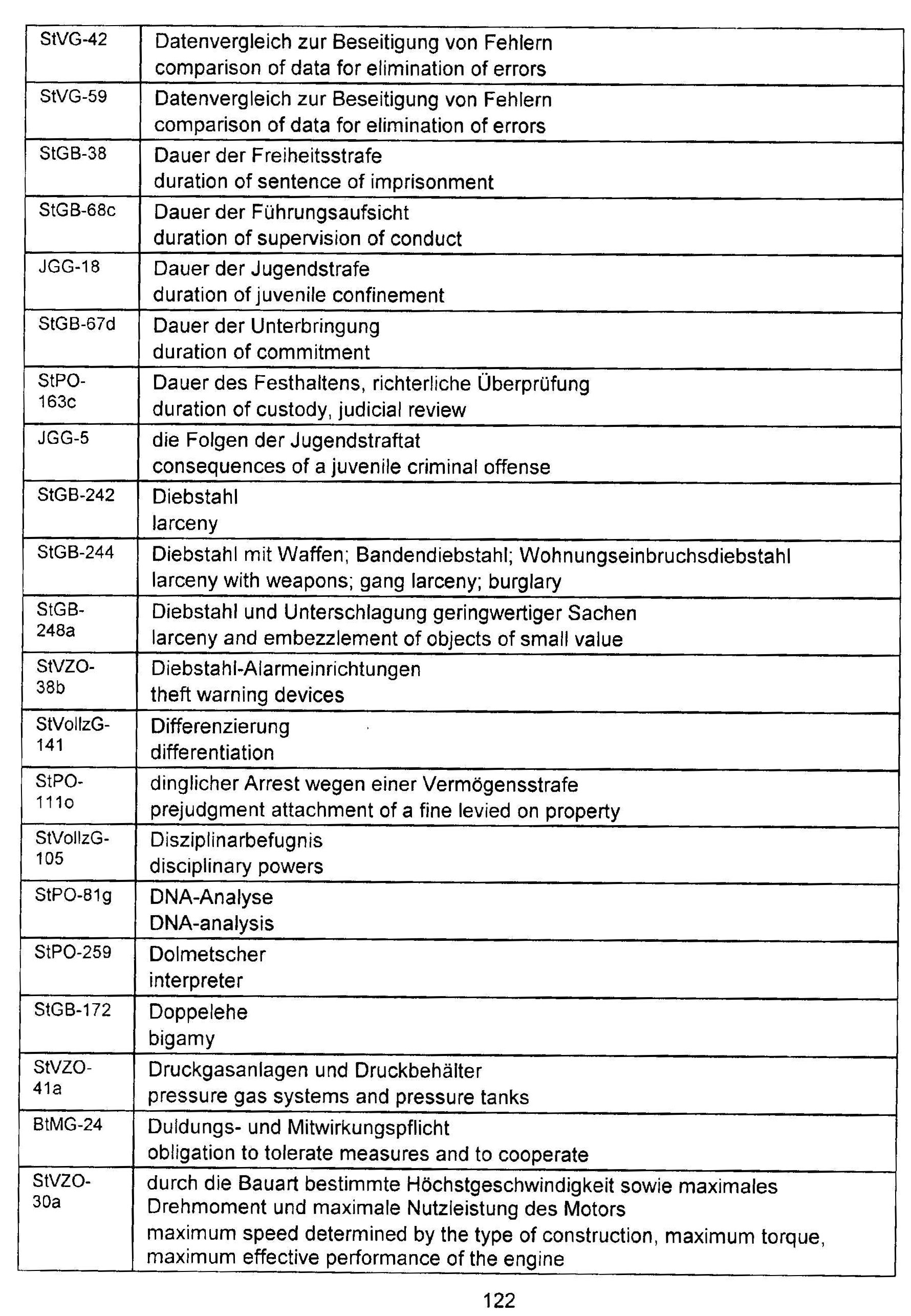
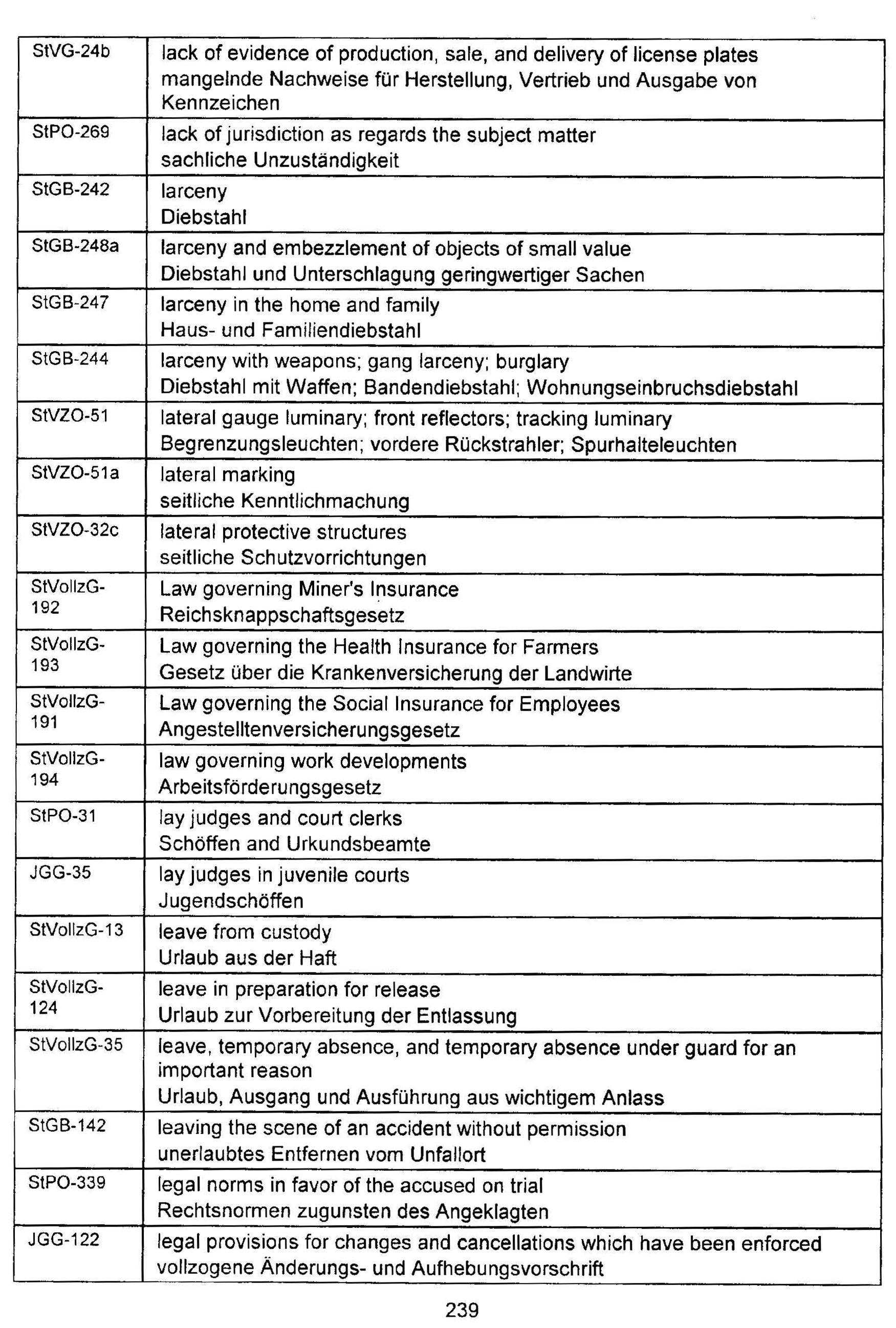
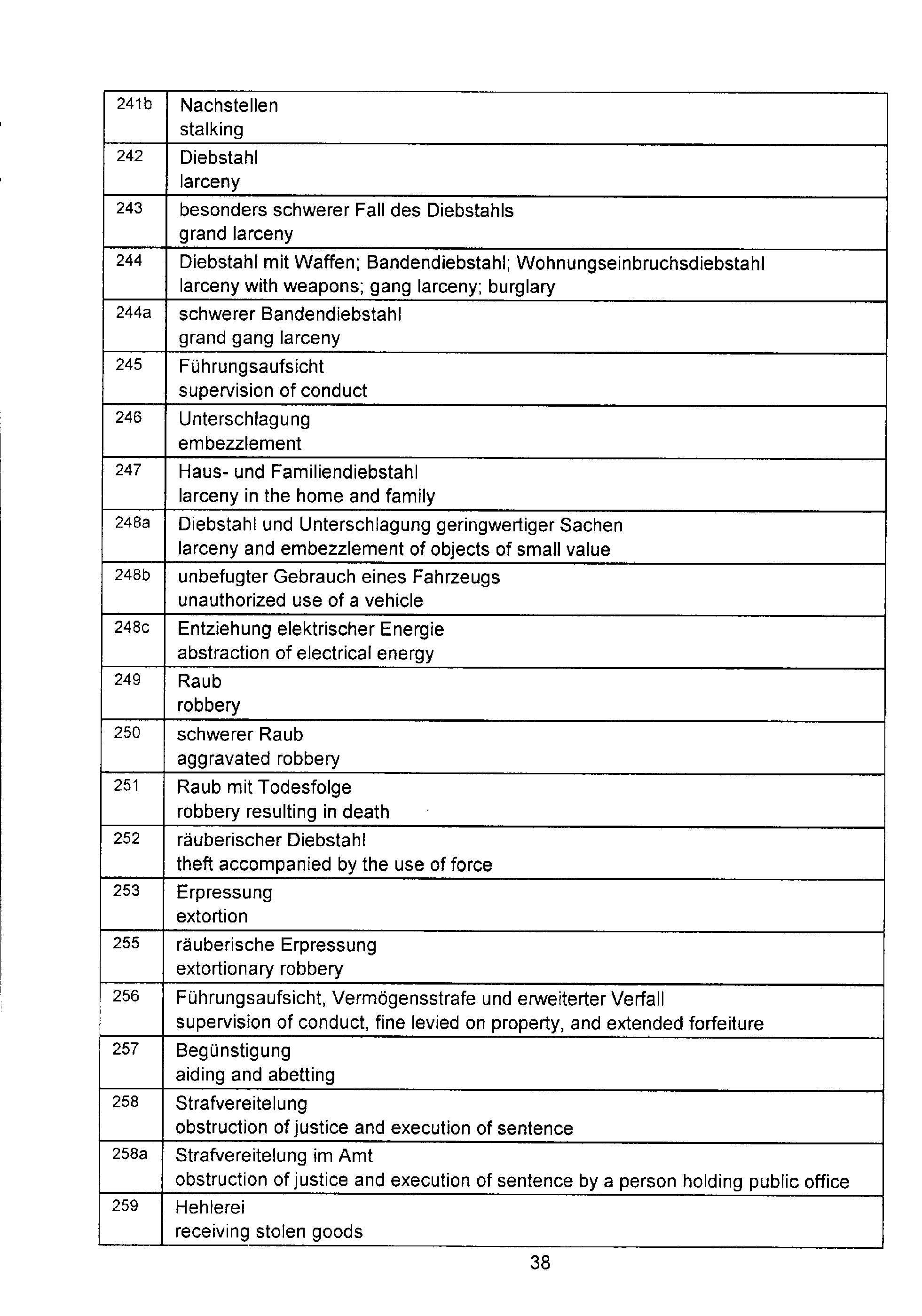
I’ve mentioned Jerry (Gerold) Harfst’s book Die Besondere Übersetzungshilfe before , but now I can present some pages from it to show what it’s like.

The book is a criminal law glossary divided into three sections: in the first, the German terms are arranged by order of paragraph number: that is, first comes the Betäubungsmittelgesetz with entries from 1 to 39, then the Jugendgerichtsgesetz, Ordnungswidrigkeitengesetz, Strafgesetzbuch, Strafprozessordnung, Strafvollzugsgesetz, Straßenverkehrsgesetz, Straßenverkehrsordnung, and Waffengesetz.

Second comes a German-English glossary, and third an English-German glossary. In each of these, the section numbers are given in the margin.

Thus an interpreter in court might want to use the section arranged by paragraph numbers, for instance in a case about drugs.

Example:

P. 38: StGB 242 Diebstahl: larceny (the US term for theft)
p. 122: Diebstahl: larceny (StGB-242)
p. 239: larceny: Diebstahl (StGB-242)

Click on pictures to enlarge:

harfst38w.jpg

harfst122w.jpg

harfst-239w.jpg

The quality of the printing is good, unlike my scans, which are reduced to make smaller files. More information and ordering here.

Extraordinary rendition

The World Wide Words newsletter, whose RSS feed I read, has chosen the term extraordinary rendition to comment on.

In US law rendition refers to the transfer of individuals by what is called extra-judicial process (kidnapping, in plain speech) from a foreign country to the USA to answer criminal charges. The defendant is said to have been rendered up to justice.
A problem for the security forces is that once brought to the USA the person is subject to US law and the rules of due process, which of course excludes torture. Hence extraordinary rendition, a euphemism for taking them to a country where these rules do not apply.
From the Independent, 1 Jul. 2005: One week ago a judge in Milan signed warrants for the arrest of 13 of the agents, which has thrown covert CIA activities outside the US under the spotlight and drawn attention to the increasingly common practice of so-called ‘extraordinary rendition’, by which the US seizes terror suspects and removes them to countries known for their use of torture.

Außergewöhnliche Auslieferung, I suppose. Here’s a German article of June 2005 using that term:

Italien: Erstmals geht Justiz in Europa gegen US-Praktiken des Kidnappings Verdächtiger vor. Klarnamen von Geheimdienstagenten an Mailänder Konsulat aufgedeckt

The terms Kidnapping and Verschleppung seem to be more common. See heise.de.
For rendition, Romain has ‘Überstellung von Straftätern (ohne förmliche Auslieferung)’.

Wikipedia has something about it too.

EC Asparagus Directive/EG Spargel-Richtlinie

Here it is in German, with links to all other languages.

We don’t talk of translation here – all versions of the EU directives are original legal texts. But this is odd:

in Erwägung nachstehender Gründe:
(1) Spargel ist in Anhang I der Verordnung (EG) Nr. 2200/96 als eines der Erzeugnisse aufgeführt, für die Normen festzulegen sind.

Whereas:
(1) asparagus are among the products listed in Annex I to Regulation (EC) No 2200/96 for which standards must be adopted.

And again later:

The condition of the asparagus must be such as to enable them:

Asparagus is treated as a plural! But what about this?

Asparagus is graded into three classes defined below:

In fact, plural and singular use are mixed. This means that a number of lawyers drafting legislation for the EU are capable of writing a text without being consistent as to whether the main term is singular or plural. Why am I not surprised?

The OED has no illustrations of this, although others seem to want to count.

I see asparagus as a mass noun/uncountable. German has Spargel, but counts as Spargelstangen and Spargelköpfe.

And here’s some of the important bit:

Die Spargelstangen werden nach ihrer Färbung in vier Gruppen eingeteilt:
1. weißer Spargel;
2. violetter Spargel: der Spargelkopf muß eine rosa bis violettpurpurne und ein Teil der Spargelstange muß eine weiße Färbung aufweisen;
3. violett-grüner Spargel: Spargel mit teilweise violetter und grüner Färbung;
4. Grünspargel: der Spargelkopf und der größte Teil der Spargelstange müssen eine grüne Färbung aufweisen.
Diese Norm gilt nicht für Grünspargel und violett-grünen Spargel mit einem Durchmesser von weniger als 3 mm und für weißen und violetten Spargel mit einem Durchmesser von weniger als 8 mm, der in einheitlichen Bündeln oder Packstücken abgepackt ist.

Asparagus shoots are classified into four groups according to colour:
1. white asparagus;
2. violet asparagus, having tips of a colour between pink and violet or purple and a part of the shoot white;
3. violet/green asparagus, part of which is of violet and green colouring;
4. green asparagus having tips and most of the shoot green.
This standard does not apply to green and violet/green asparagus of less than 3 mm diameter and white and violet asparagus of less than 8 mm diameter, packed in uniform bundles or unit packages.