Bells / Glocken

800px-Klosterfuerstenfeldinnen.JPG

I have just been translating this . I decided to call the Raumtor separating nave and choir something like a proscenium arch. When I was reminding myself how to describe bells, I found a nice site with information on spotting bells in Gloucestershire, especially by car:

Charlton Kings, S Mary, 8 bells, Tenor 17-0-13, Grid Ref:SO964204
Parking is available in the lanes which surround the church, and the tower entrance is in the south east corner of the tower, on the outside of the church. The bells go quite well, but are not particularly clear to listen to, and the ringing chamber ceiling is fairly low. They were rehung by the Whitechapel foundry in 1958 in a new frame with new fittings. The fourth bell here was for a long time thought to be by John Palmer of Gloucester. It has been discovered that the founder “IP” that Sharpe and H.B.Walters before him assumed to be John Palmer, was in fact a founder called John Pennington. John Pennington I was casting bells at Monmouth between 1626 and 1665, and his son John II was casting until 1682.

Gives a whole meaning to the term ‘well hung’.

Translator’s desk /Übersetzerschreibtisch

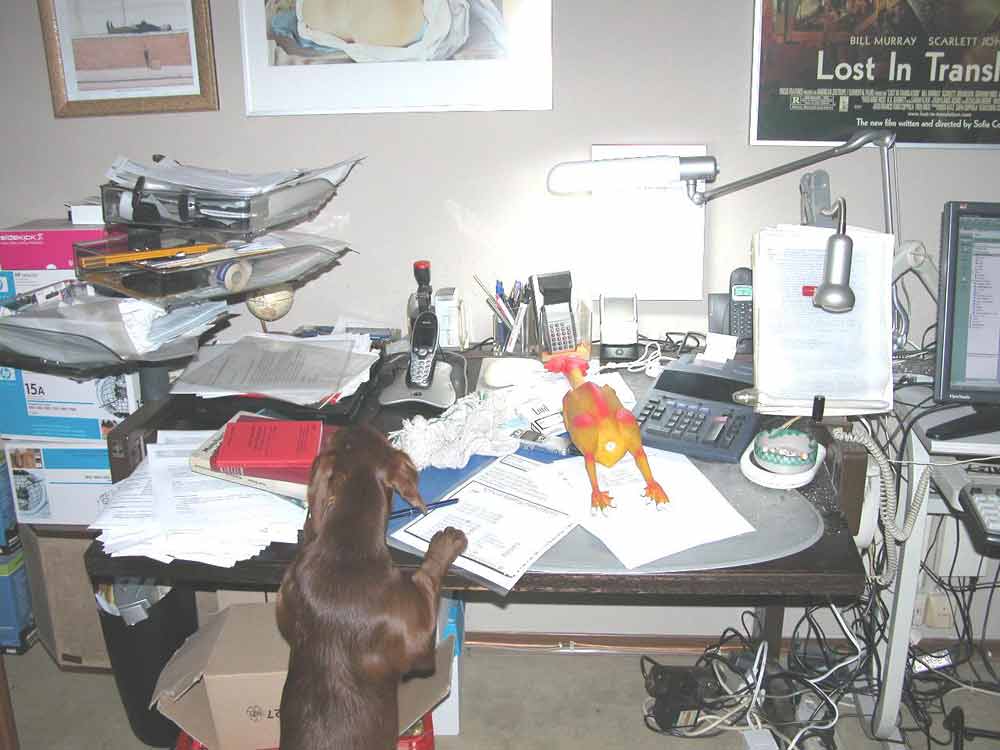
Further to the earlier entry, I am able to present two photos of the desk of a translator not unknown in the comments to this weblog, Paul Thomas in Baden-Württemberg (click to enlarge):

desk2w.jpg

The rubber chicken was not placed there for effect, but thrown there by the office assistant, shown here:

desk1w.jpg

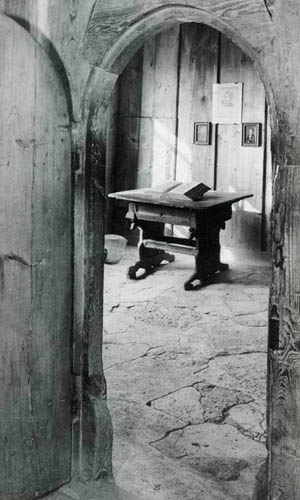
Analysing other people’s desks looks like a future growth area to me. I spotted the globe to the left, and Paul states it was a freebee (Werbegeschenk). We note the monitor is not on the desk itself – this is a procedure with a long tradition: Luther didn’t have his monitor on his desk either:

luthersdesk.jpg

Tidy desk seminar/”Mein Schreibtisch, frei und aufgeräumt”

This is not a description of my desk but the title of the seminar for translators I went to in Munich on Saturday. It was about keeping your desk tidy. Of course, an untidy desk is a symptom rather than a disease.

Here is a picture of a translator’s desk that looks a bit tidier than its title suggests. It’s probably the desk of someone who’s already attended such a seminar. In an ordinary office, we learnt, this pencil stand (Stiftbehälter) would be full of bent paperclips, rusty nails and pencils that no longer write. But I can’t see anything really extraneous, although the wall looks promising.

The trainer was Gunter Meier, who has a company website (more E+E – details there of his book on dealing with email too). People who work in offices have more chance to hear about this kind of thing. It’s a shame so few people attended – apparently there were 30 in Aschaffenburg. Probably there’s just too much else to do in Munich.

There was a list of common reasons why it’s hard to throw stuff away, from trivial to neurotic. I found these interesting for reasons I won’t go into. Also: need for archives; analysis of usual use of office space; how to avoid using post-it notes.

There was a reference to the way that old stuff carries old associations and you can only think new thoughts if you get rid of these ‘anchors’: the same old pictures, objects on desk, cuddly toys and so on. I saw these 10 seriously cool workplaces last week, and this reminded me. I particularly liked the slide to go from floor to floor, but I suppose that wouldn’t make me more productive.

St. Isidore

St. Isidore is the patron saint of the Internet, according to an entry in h2g2 (the BBC’s pre-Wikipedia Wikipedia) on Cool patron saints.

Catholic Online has written a prayer for those using the Internet, asking for St Isidore’s intercession:

Almighty and eternal God,
who has created us in Thy image
and bade us to seek after all that is good, true and beautiful,
especially in the divine person
of Thy only-begotten Son, our Lord Jesus Christ,
grant we beseech Thee that,
through the intercession of Saint Isidore, bishop and doctor,
during our journeys through the Internet
we will direct our hands and eyes
only to that which is pleasing to Thee
and treat with charity and patience
all those souls whom we encounter.
Through Christ our Lord. Amen.

And St. Clare is apparently the patron saint of television:

Before she died in 1253, she became too ill to attend daily mass. As she lay in her bed, she would see visions of the mass on the wall of her cell, just like there was a TV. Pretty cool, huh?

Yes, I’m researching terminology on a Cistercian church.

Interview with Henry Pavlovich on chartered linguists

Céline has posted an interview with Henry Pavlovich from the latest edition of The Linguist. He mentions the criteria being discussed.

As this is an achievement and mark of approbation for the profession of linguists as a whole, membership of any ONE approved professional body in the language field (eg IoL, ITI, AIIC) will be sufficient.

This still begs the question of why a charter should be granted to the profession of linguist, which I take to mean language teacher, translator or interpreter (in the USA it would be taken to mean a specialist in linguistics too).

Those who think it would be good to be a chartered translator still think it odd that the IoL should have the charter, since the ITI came into existence, apparently, because the IoL thought the translators’ group in the IoL was getting a bit above itself.

Translation in The Guardian

Bild

Eva Braun wollte zehn weitere Frauen haben, die aber wegen der totalen Mobilmachung … nicht sofort zu Stelle waren. Darüber beklagte sie sich bei Hitler. Der war empört und herrschte Bormann zornig an: ‚Ich stampfe ganze Divisionen aus dem Boden. Da müßte es doch ein leichtes sein, ein paar Mädels für meinen Berghof zu beschaffen! Organisieren Sie das!‘“

Guardian:

…on one occasion, he flew into a rage when it proved difficult to hire 10 more serving girls. “I stamp whole divisions into the dirt!” screamed Hitler. “And I can’t get a few more serving sluts for the Berghof?”

Bild:

Als es um die Aufmachung der Damen ging, scherzte Hitler über Eva Brauns Lippenstift, der Spuren an der Serviette hinterließ. Lachend meinte er, jetzt, in der Kriegszeit, stelle man Lippenstiftersatz aus Tierkadavern her.“

Guardian:

He would laugh at Eva’s lipstick on a serviette and then say, ‘During wartime lipstick is produced out of dead bodies.'”

Bild is not the source of the Guardian quotes, but it looks as if the German both report on has got mangled a bit (bold by MM).

(Thanks to the GerNet list on the ITI)