Paper, cans, litter, Top Language Jobs.


Paper, cans, litter, Top Language Jobs.
The Chav Nativity – picture and text at Charon QC
Then these three geezers turn up, looking proper bling, wiv crowns on their heads. They’re like ‘Respect, bay-bee Jesus’, an’ say they’re wise men from the East End.
Joe goes: ‘If you’re so wise, wotchoo doin’ wiv this Frankenstein an’ myrrh?
Why dincha just bring gold, Adidas and Burberry?’
A Google image search reveals others.
In The Parking Ticket Awards: Crazy Councils, Meter Madness and Traffic Warden Hell, Barrie Segal (described by some as Britain’s leading expert on traffic tickets) collects odd parking tickets.
amazon.de link:
The Parking Ticket Awards: Crazy Councils, Meter Madness and Traffic Warden Hell
Examples in this article:
Robert McFarland’s horse was given a parking ticket under the heading, “Vehicle Description: Brown Horse”.
A motorist who received a ticket in an NCP car park, despite returning to her car an hour early, was told the attendant had fined her because he had “reasonable cause to think she would stay longer than the four hours for which she had paid”.
Here’s a picture of a British parking ticket (not my car):

Segal also runs a website helping people to fight parking tickets.
www.strafzettel.de looks considerably more strait-laced.
(via Legal Juice)
Drei Möwenküken auf dem Dach eines Gebäudes in Bournemouth, an der englischen Südküste, wurden auf Veranlassung von einer Anwaltskanzlei von Schädlingsbekämpfern getötet, zum Leidwesen vieler Zuschauer, u.a. aus einer anderen Kanzlei.
Under the heading Gulls ‘Strangled’ In Front Of Staff, the Bournemouth Daily Echo reports:
STAFF at offices in Bournemouth were left horrified and in tears after watching three seagull chicks killed in front of them because they were deemed a health and safety risk.
The seagull family lived on the roof of Harold G Walker solicitors in Oxford Road, Bournemouth, and the young chicks had become favourites among staff in surrounding buildings.
Apparently members of the Crown Prosecution Service were watching too.
The story was also taken up by the Law Society Gazette and RollOnFriday (the latter writes ‘No-one mention the hawk in Broadgate’, but that would be the perfect antidote, of course).
The commenters on the Daily Echo are incensed and will not use the services of Harold G Walker in future. One writes (my emphasis):
What Harold Walker has failed to grasp is the impact on the people who have witnessed this incident as it was carried out in an unprofessional manner. ProKill are incorrest to quote that they followed the guidelines as I would like to know where DEFRA state that you are allowed to stamp on a birds head. I would like to add that we are not talking once ,but for several moments so death did not come quickly to the creature, and to add insult to injury to wave at the staff who had come out of their offices in shock is just unbelievable.
There is a certain escalation in the comments.
Following the recent entry on changes to court dress in England and Wales, RA-Blog gives a link to a page with pictures of judicial dress all over the world.
It’s not quite accurate when referring to England and Wales – not surprisingly, since the situation is so complicated. And in England and Wales, ‘justices’ doesn’t refer to judges, but to lay magistrates.
>>Like everything else in Britain, British judicial costumes are regulated according to a myriad of ancient traditions, customs, and laws. Many of these rules date back to at least the 14th Century, making the modern British judicial system one of the world’s oldest.<< Does their dress date back that far? I don't think wigs were worn then. And what happened to 1066? I can't speak for Scotland and Northern Ireland (the page has separate pictures for Scotland later). >>The British judicial branch is very complex, and is composed of dozens of different courts of jurisdiction<< Not dozens. >> with grandiose names like the “Queen’s Bench” the “Chancery Division” and the “Crown Court.” Depending on which branch the judge belongs to, he could wear one of many different costumes. Unlike many other countries which limit their judges to wearing only red or black, in Britain judges wear almost every color. There are judges with blue robes, green robes, white robes, and even purple and pink ones. << I haven't checked the number of colours, but I have my doubts. >>There are several constants, however. All upper court justices in Britain wear the famous “full bottomed” powdered wigs while lower court judges wear the shorter “barrister” wig. << The full-bottomed wig is only for ceremonial occasions. In court they wear the bench wig - except the House of Lords judges, who don't wear wigs at all. On wigs, see earlier entry.
>>This is a holdover from the time when judges were members of the aristocracy, and it was considered fashionable for important people to show off their social status by wearing long flowing wigs. Once a year there is a special ceremony in Westminster Abbey during which all of the nation’s judges assemble to commemorate the start of the legal year. On formal occasions such as that, all judges wear “full bottomed” wigs.<< Exactly, and not on other occasions. The ceremony referred to is the Lord Chancellor's Breakfast. The picture of "more high court judges" with purple trim and full-bottomed wigs is a picture of the procession to the Lord Chancellor's Breakfast. Those are not high court judges, but circuit judges. By the way, the 'cross collar' is called 'bands'. For lots of pictures, including circuit judges in ordinary and ceremonial dress, see the wonderful PDF Legal Habits.
Another mystery to me is the picture that says ‘A lower court judge’. I don’t know what a lower court judge is supposed to mean – it can only mean a circuit judge (not a district judge, I think), and I don’t think it’s one of those. (The term ‘upper court’ quoted earlier is also dubious). I think it’s another manifestation of a high court judge. Here it is – any offers?
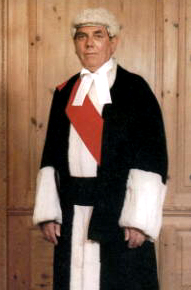
I’ve got a bit inured to English court dress, so I find the German Federal Constitutional Court judges the oddest. Their hats could have been designed for 2001. And I believe when they were invented, a theatrical costumier was consulted.
The Solicitors Journal reports that from January 2008, judges’ clothing in England and Wales is to be simplified and their dress allowance reduced. This was announced on July 12. Media release here.
Judges will no longer wear wigs, wing collars and bands when sitting in open court in civil and family proceedings. The Circuit Bench, in accordance with their current wish, will continue to wear the same gown. All other judges will wear a new, simple, gown which is in the course of desigm-
In criminal proceedings, High Court Judges will wear the present winter robes. At the moment, High Court Judges have five different styles of dress for different situations.
Advocates (mostly barristers but some solicitors) will similarly not wear wigs, wing collars and bands in civil courts.
For a picture of the High Court Judge dress to remain, see earlier entry.
Wikipedia has some information on current court dress. Examples with pictures here.
The judges of the House of Lords wear no wigs and gowns, just dark suits. That is apparently because they are sitting as a committee of the House of Lords rather than a court in the usual sense.
