The Special Translation Tool/Die Besondere Übersetzungshilfe

I’ve mentioned Jerry (Gerold) Harfst’s book Die Besondere Übersetzungshilfe before , but now I can present some pages from it to show what it’s like.

The book is a criminal law glossary divided into three sections: in the first, the German terms are arranged by order of paragraph number: that is, first comes the Betäubungsmittelgesetz with entries from 1 to 39, then the Jugendgerichtsgesetz, Ordnungswidrigkeitengesetz, Strafgesetzbuch, Strafprozessordnung, Strafvollzugsgesetz, Straßenverkehrsgesetz, Straßenverkehrsordnung, and Waffengesetz.

Second comes a German-English glossary, and third an English-German glossary. In each of these, the section numbers are given in the margin.

Thus an interpreter in court might want to use the section arranged by paragraph numbers, for instance in a case about drugs.

Example:

P. 38: StGB 242 Diebstahl: larceny (the US term for theft)
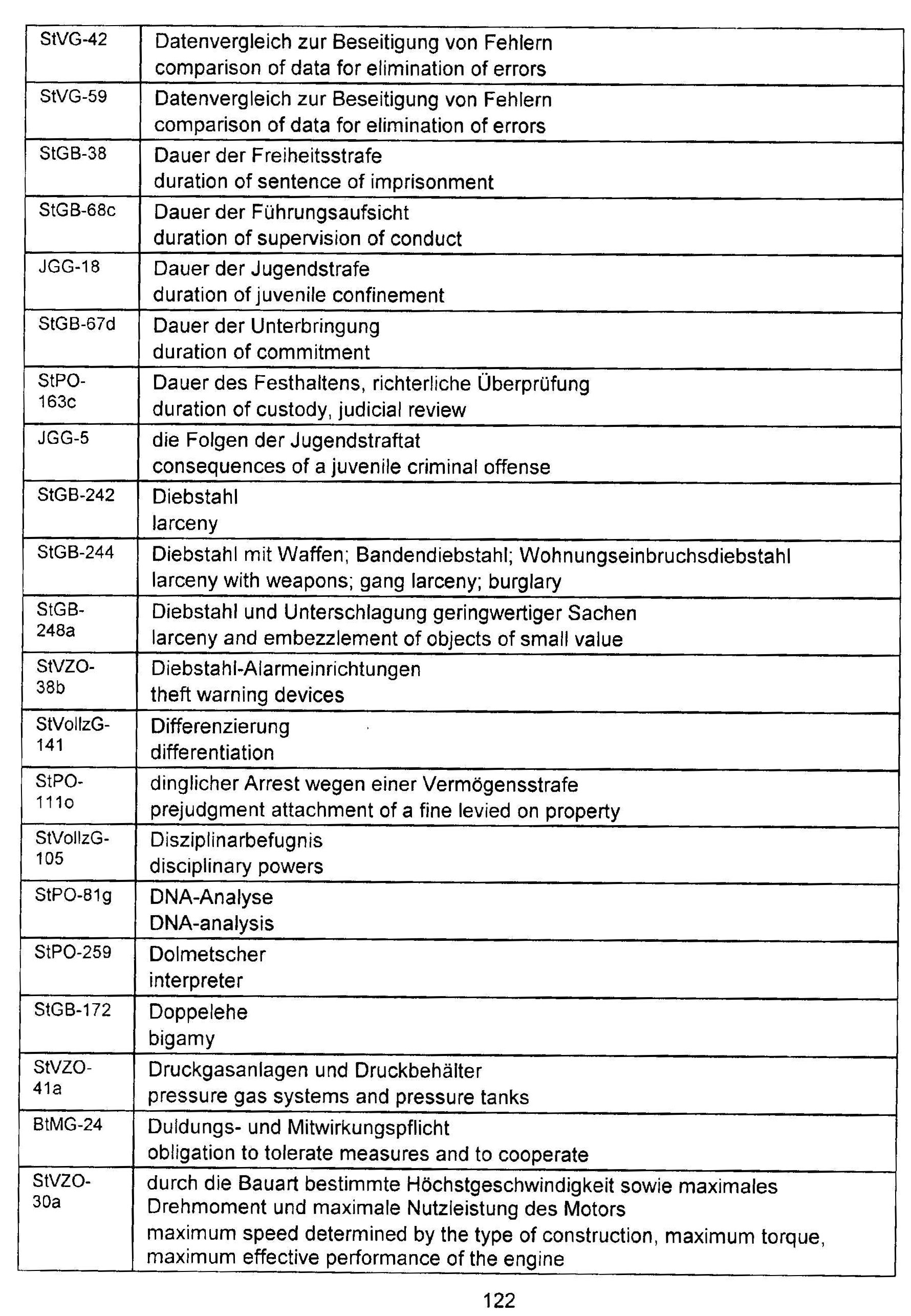
p. 122: Diebstahl: larceny (StGB-242)
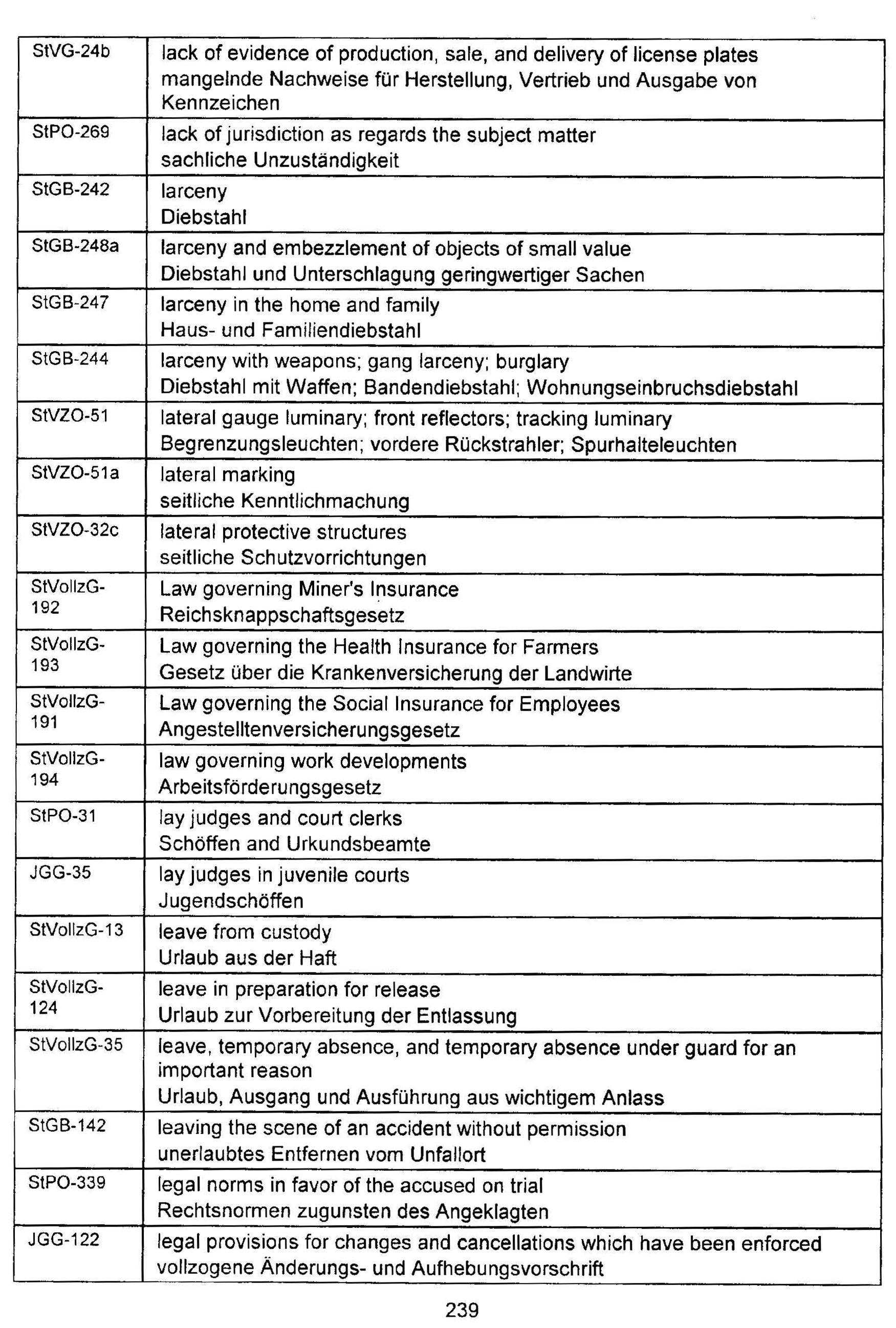
p. 239: larceny: Diebstahl (StGB-242)

Click on pictures to enlarge:
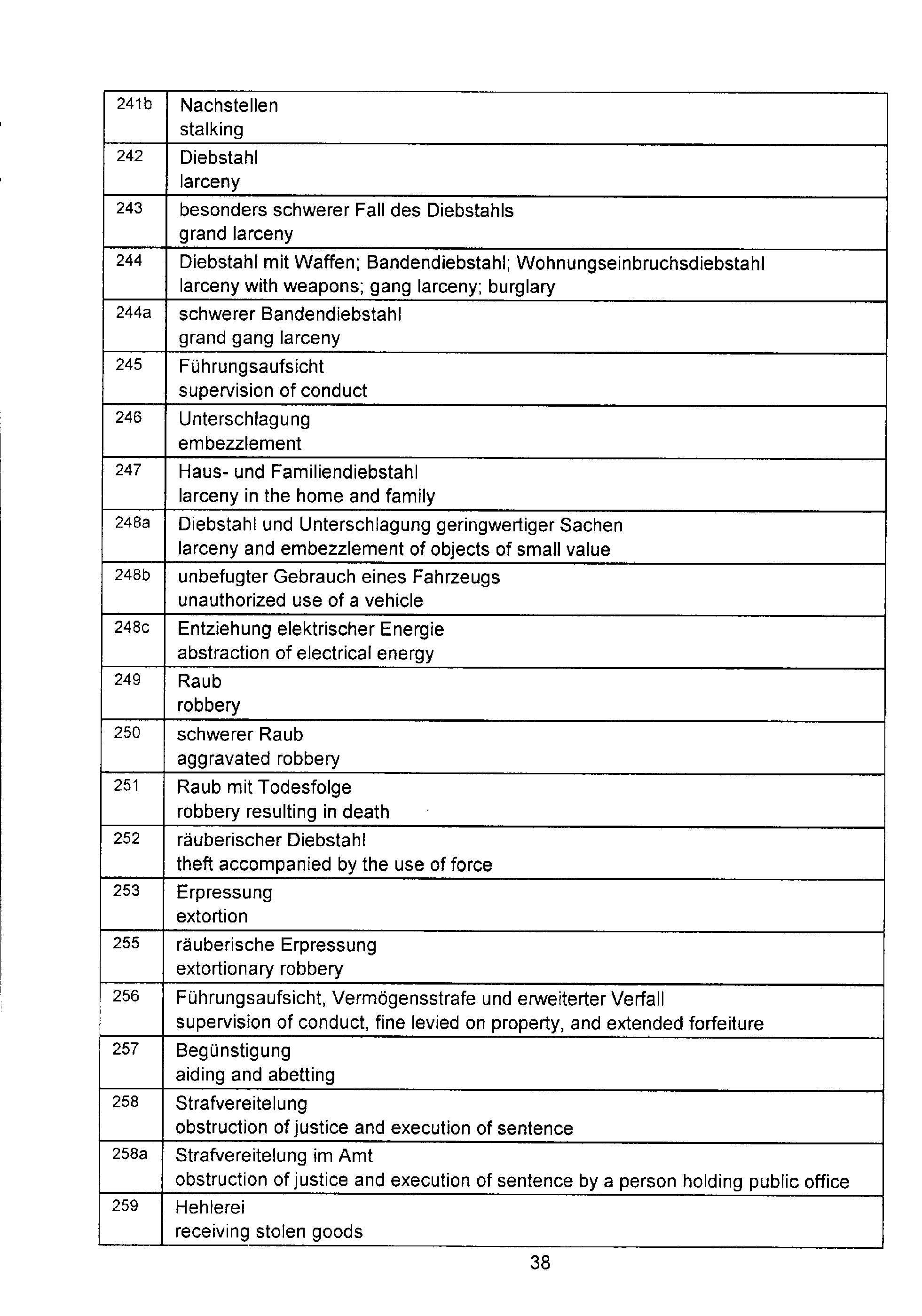
harfst38w.jpg

harfst122w.jpg

harfst-239w.jpg

The quality of the printing is good, unlike my scans, which are reduced to make smaller files. More information and ordering here.
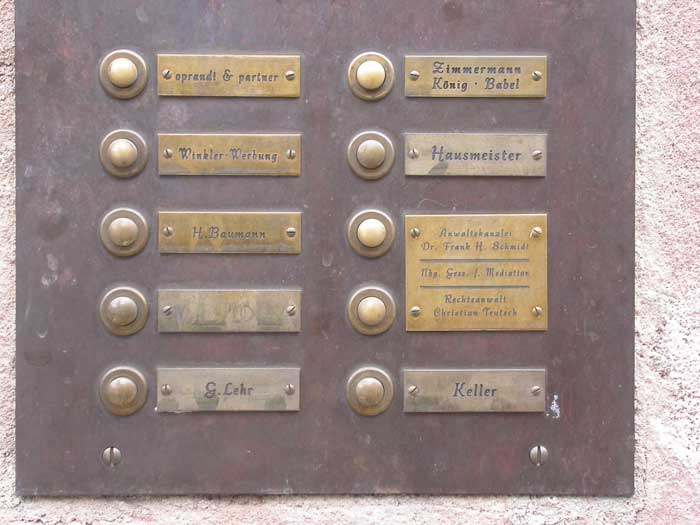
Doorbells and weblogs

Stuart Mudie asks in a comment to the last entry whether I’m trying to compete with Andrew Losowsky. Well, I had not seen his doorbell pictures although I had heard of Barçablog.

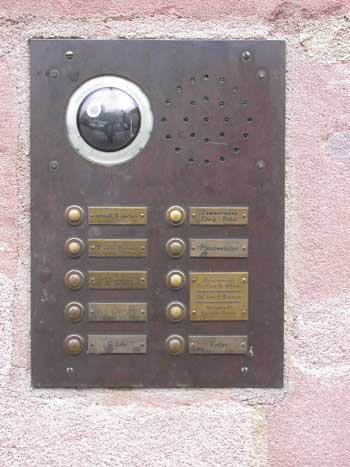
Anyway, I can’t say at the moment when I took my first doorbell photo, but it was before the first posted here on September 16th 2003. And I see that was about the time Andrew started noticing the Florence doorbells. On September 21 2004 he writes:

Nearly a year ago, I was wondering around Florence and found myself unnecessarily fascinated by a single aspect of that Renaissance city of incredible art and breathtaking architecture: the doorbells.

He adds a short fiction to each picture now (here’s an example – being a literal sort of person, I was disappointed by a fiction).

I am not trying to say Look I was first! I just don’t want people thinking I got the idea from a famous and trendy blogger.

door4w.jpg

door5w.jpg

(Nürnberg)

Jurawiki

From Langenhan, Rainer and Melanie, Internet für Juristen, 4th ed. 2003, ISBN 3 472 05106 X (Rainer Langenhan is the author of the HandAkte WebLAWg), a definition of wikis. I had seen wikipedia but didn’t realize what a wiki was. ‘Wikipedia is a multilingual project to create a complete and accurate open content encyclopedia. ‘

Wikipedia itself has a law section, and if you click on Deutsch, you get a German law page in real German, not (as one always fears now) a page of Babelfish MT gibberish.

I looked up equity, found the maxims, and was surprised by some of them.

Plain English has turned Equity aids the vigilant and not the indolent into Equity aids the vigilant, not those who sleep on their rights. Equity does not require an idle gesture was new to me, to say nothing of the law students’ summary in a final maxim (must be American).

There’s also a German law wiki. Some interesting notes on Aktenzeichen led me to rather painstaking allocation of cases in Saxony (Amtsgericht Dresden). When allocating cases by the parties’ last names:

‘Außer Betracht bleiben dabei

Adelsbezeichnungen;
die Zusätze Abdel, Abu, al, auf dem, auf der, auf die, Ben, d’, da, dal(a), dall(a), de, del, dell’, delle, del la, della, di, do(s), du, el, la, le, lo, M’, Mac, Mc, N’, O’, tel, tem, ten, ter, van, van de, van den, van der, van ten, van ter, vom, von, von dem, von der, von zu (m,r) und zu (m,r);
bei Doppelnamen der zweite Name.
Diese Regelung gilt ohne Rücksicht auf die Schreibweise und unabhängig davon, ob ein Bindestrich verwendet wird oder mehrere dieser Zusätze Bestandteil des Namens sind.’

Berufsakademie / Fachhochschule

A colleague, Paul Thomas from Ehningen, translated two certificates containing the word Berufsakademie, which he rendered as vocational academy. The client – a German – was annoyed and said the translation was wrong: it should have been University of Cooperative Education.
Paul searched the Web and found the term almost exclusively used on German Berufsakademie websites.

I don’t know these Berufsakademien – they are a Baden-Württemberg thing, and I’m in Bavaria. There’s a site here.

They sound a bit like polytechnics. But what does cooperative mean?

Eurybase definitely puts them outside higher education. It says they are in eight Länder.

‘Berufsakademien (professional academies) form part of the tertiary sector and combine academic training at a Studienakademie (study institution) with practical professional training in the workplace, thus constituting a dual system (duales System). They were first set up in 1974 in Baden-Württemberg as part of a pilot project and are now to be found in Baden-Württemberg, Berlin, Sachsen and Thüringen, where they are state-run, and in Schleswig-Holstein, Niedersachsen and Saarland, where they are privately maintained state-recognised institutions.’

The DAAD book: Wörterbuch Englisch, Französisch, Spanisch – Begriffe aus Wissenschaft und Hochschule (ISBN 3 7639 0418 2) gives ‘higher education institution in Germany with professional orientation and on-the-job training’.

And Raddatz’s Fachglossar: Deutsche Berufsbildungsbegriffe, Bertelsmann/GTZ (ISBN 3 7639 0128 0), otherwise full of Germanisms, has ‘vocational college’ plus ‘The vocational college which exists in some Federal States of Germany prepares, as a rule, upper secondary school graduates … in a three-year period for a qualified graduation for a scientific and advanced occupational activity. The training scheme features in-company training periods.’

So what do we do when a whole set of institutions has chosen a term that is rubbish in English? Their very choice seems to disqualify them. A similar term is University of Applied Science for Fachhochschule. There’s a term that Eurybase does support. It reminds me of the Holy Roman Empire – neither holy, nor Roman, nor an empire.

Paul calls it ‘what would appear to be a misnomer made up by German speakers for German consumption’. Tim Slater replies, ‘Well, of course it is not for German consumption, but for misleading an international readership (part of unscrupulous and dishonest sales promotion by German authorities)’.

The conclusion on FLEFO at CompuServe was: use the German term, if only once in brackets, make sure you get paid, and let the client do what it wants with the text.

Zusammenfassung: das Wort Berufsakademie wird standardmäßig mit einem sinnlosen englischen Begriff übersetzt, vor allem auf den Webseiten der Berufsakademien. Kunde, der die beeidigte Übersetzung zweier Urkunden wollte, bemängelt Übersetzung deswegen. Übersetzer klärt Kunden auf. Fazit: wenn der Kunde dem englischsprachigen Übersetzer nicht glauben will, oder ihm sogar glaubt aber sich an der eingebürgerten Form halten will, soll er es tun.
Website von Eurybase – Eurydice Database – gibt zweisprachige Entsprechungen für Bildungsbegriffe in ganz Europa.

Wörterbuch der deutschen Gegenwartssprache

Die Zeit provides Wörterbuch der deutschen Gegenwartssprache online – reported by Handakte WebLAWg

An der Berlin-Brandenburgischen Akademie der Wissenschaften wurde Anfang März 2003 durch das Projekt “Digitales Wörterbuch der deutschen Sprache (DWDS)” das größte frei zugängliche, online abfragbare Wörterbuch für die deutsche Sprache zur Testbenutzung frei geschaltet.