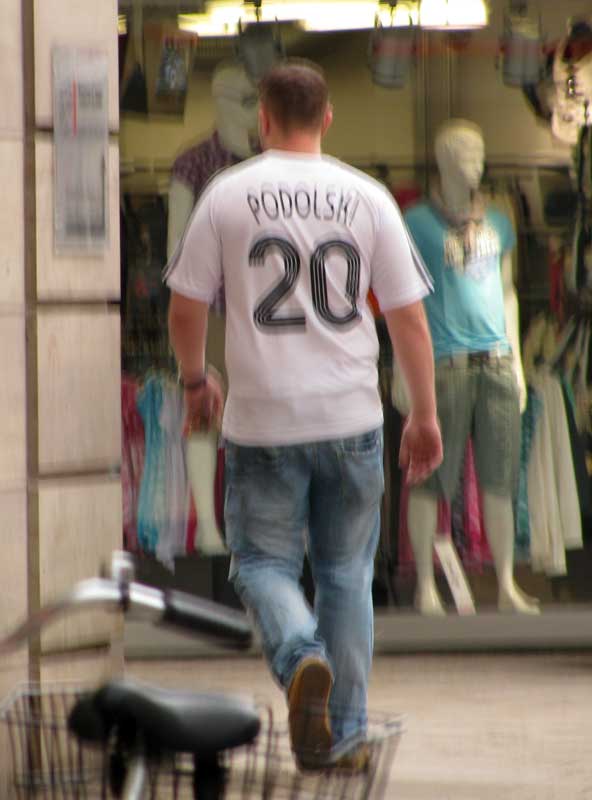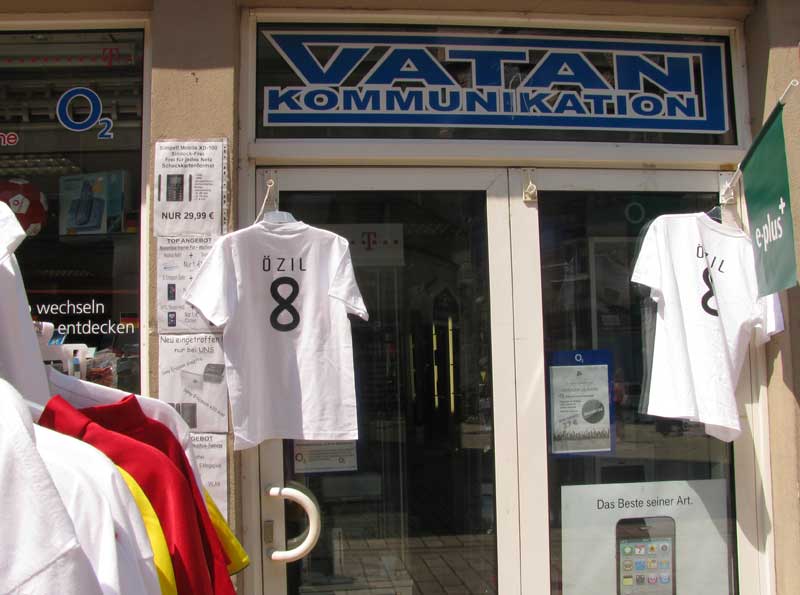
Özil

There are priorities in Fürth.

Meanwhile, there’s a story at fucked translation of a ‘bad pass’ by Özil reaching Spanish as a ‘fake passport’.

Here’s the source, at Malaprensa:

En la noticia de Bild, que es simplemente un comentario al partido con Inglaterra, Hiddink dice:

Guus Hiddink (türkischer Nationaltrainer): „Schade, dass Özil sich für den falschen Pass entschieden hat. Er ist ein moderner Fußballspieler, den ich in meinem Team gut gebrauchen könnte.

Que traducido por Google translator, es:

Guus Hiddink ( entrenador del equipo turco nacional): ” Lástima que Özil eligió el paso equivocado. Él es un futbolista moderno , bien podría utilizar en mi equipo.

Actually, since Bild was avoiding anglicisms – if not particularly on that date – it wasn’t a bad pass, nor a fake passport, but the wrong passport – if Özil had chosen the Turkish passport, he would have been in Hiddink’s Turkish team.

LATER NOTE: I see the story has got further. In fact, Google has a mass of links on the ‘Özil fake passport claim scandal’.
Football support/Fußball 2

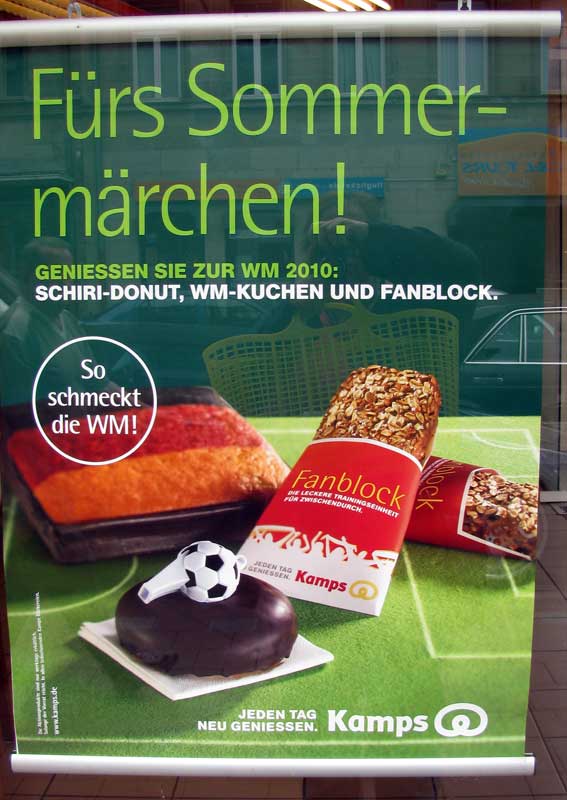
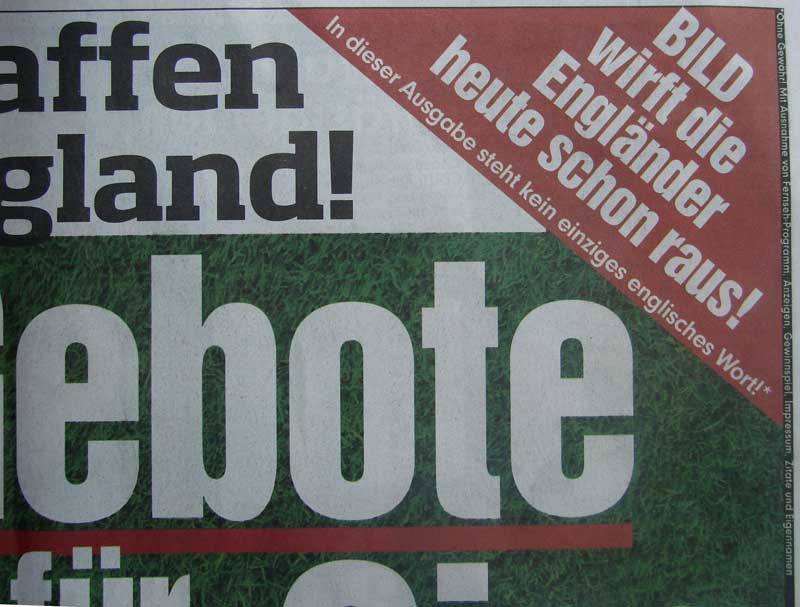
Yesterday BILD claimed it was appearing without any English words. I can’t confirm this. I do wish commentators would pronounce ‘Stephen Gerrard’ with emphasis on the first syllable of his surname.

How to pronounce Steven Gerrard.

I found another call for avoiding anglicisms from a publication called Deutsche Sprachwelt in Erlangen:

Anläßlich des WM-Achtelfinalspiels zwischen Deutschland und England am Sonntag ruft die DEUTSCHE SPRACHWELT ganz Deutschland dazu auf, während des gesamten Wochenendes entschlossen auf Anglizismen und englischsprachige Lieder zu verzichten. „Setzen wir ein Zeichen, daß Deutschland hinter der deutschen Mannschaft und hinter der deutschen Sprache steht!“, forderte der Chefredakteur der Sprachzeitung, Thomas Paulwitz.

Instead of public viewing (which I did see in an advert in BILD), Rudelgucken should be used. Ferrero and kicker have produced an album containing words like goal, facts, and Team-Sticker.

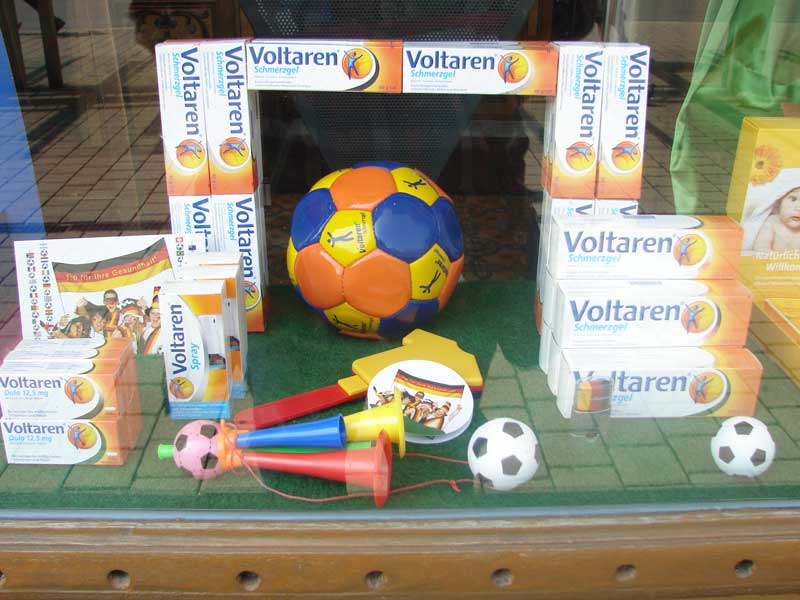
Meanwhile, the Apotheken are inspired:

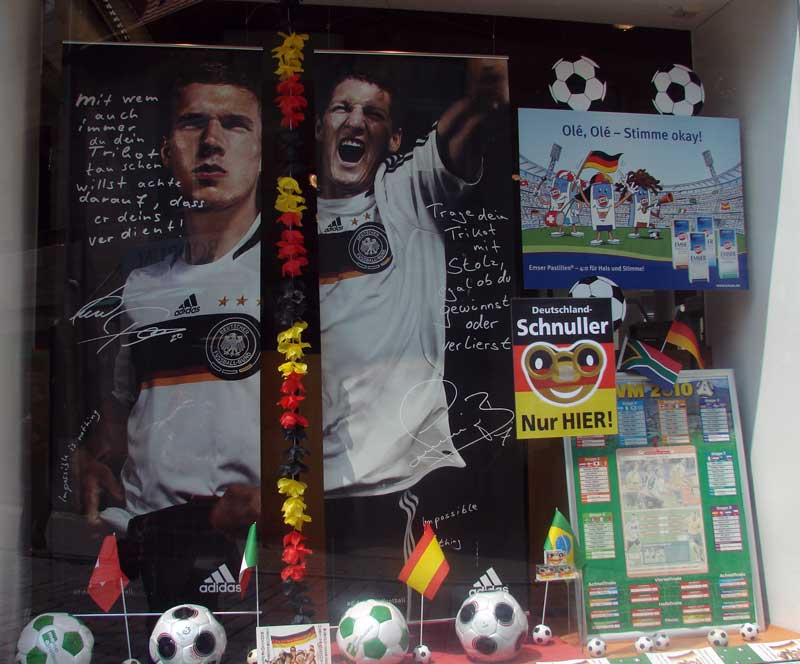
The adidas slogan Impossible is nothing also deserves consideration – it is claimed to mean something different from Nothing is impossible.

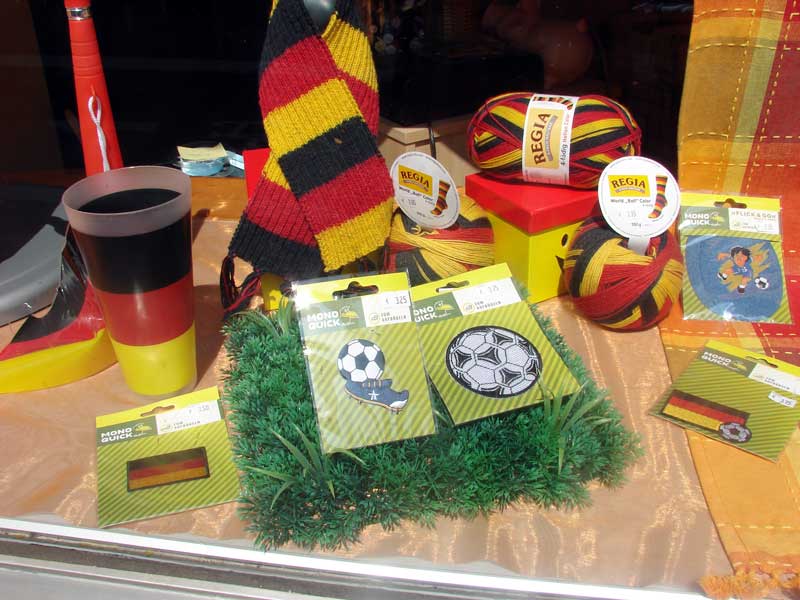
Wool shop:

(Thanks to Chris Irwin for the Zeit reference to avoiding German in BILD)

English language/Die englische Sprache

Back to a topic we seem to have forgoten too soon: Lena singing Satellite.

When I first heard the song, I didn’t like the lyrics. I realize the music is quite catchy, Lena apparently sings it faster than the writers intended, she dances well, at least in the video, she doesn’t dress up in a bizarre evening costume or strip off in the middle. But the lyrics are old-fashioned in concept, with an attempt to make them sound fun, I suppose, by additions like ‘I painted my toenails for you’.

I don’t mean to knock Lena, I just thing the song could have been better.

But other people don’t like the song lyrics either. Then again, I suddenly realized that many commentators simply don’t understand the English!

One ‘Tusnelda’ offers a critique plus ‘translation’. Tusnelda übersetzt: Heute, Satellite von Lena!

Der Text auf Deutsch:

Ich ging überall für dich hin,(und???)
ich habe mir sogar die Haare für dich gemacht. (toll, sollte man das nicht immer machen?)
Ich habe neue Unterwäsche gekauft, in blau, (wo denn??)
und ich trug sie gleich am nächsten Tag. (klar, die wäscht man ja auch vorher!!)

Tusnelda, this is all well and good, but ‘the other day’ means ‘a few days ago’, not ‘on the next day’. Incidentally, ‘underwear dyed blue’ seems to have escaped everyone.

‘Love, I’ve got it bad for you’ does not mean ‘Liebster, es steht schlecht für dich’ but ‘Liebster, ich bin in dich verknallt’. ‘My aim is true’ means ‘genau’ – I always hit the target.

Incidentally, Thusnelda or Tussi is used pejoratively in German. Whether this has anything to do with the historical Thusnelda I don’t know. She was apparently the wife of Arminius (Hermann of the battle of the Teutoburger Forest), was taken captive to Rome, gave birth to their son Thumelicus there – he is thought to have died as a gladiator in his teens.

Value added tax/VAT ohne Bindestrich

I discovered only recently that the most authoritative places write value added tax, not value-added tax.

This goes against the normal rule that compound adjectives of this construction take a hyphen.

To quote this discussion:

Surely it should be value added tax, no hyphen, not value-added tax? See, for example: (1) (http://www.hmce.gov.uk/business/vat/vat.htm), (2) (http://europa.eu.int/smartapi/cgi/sga_doc?smartapi!celexapi!prod!CELEXnumdoc&lg=EN&numdoc=31977L0388&model=guichett), (3) (http://www.rd.go.th/publish/6043.0.html) — ALoan 00:48, 22 May 2004 (UTC)

According to the traditional rules pertaining to hyphens there should be a hyphen. But the traditional rules, still used in newspapers and magazines, and in many novels, are no longer used by advertising copy writiers nor by those who write labels on packages, nor by lots of educated English-speaking people. But I think its a good idea to follow the newspaper-and-magazine usage, for reasons that are explained in the article titled hyphen. Michael Hardy 21:39, 8 Aug 2004 (UTC)

Yes, I agree that the traditional rules would indicate that a hyphen should be used; unfortunately, until the Sixth Directive, the Value Added Tax Act 1994 and sundry other legislation is amended, the name of the tax in the EU in general and the UK in particular (however technically incorrect) is actually “value added tax” and not “value-added tax”. — ALoan (Talk) 01:52, 10 Aug 2004 (UTC)

Just saying.