Are certified translations ‘beglaubigt’?/”Beglaubigte” Übersetzungen

Die Meinung eines Bundesrichters am BGH zu dieser Frage, hier schon früher mehrmals erörtert: das Thema wurde neulich auf der u-forum Mailingliste besprochen und es gab einen Beitrag, der mich unterstützt, von einem Richter, der auch übersetzt und mit dessen Genehmigung ich es hier poste.

bq. Juristen kann man nur mit ihren eigenen Waffen (Paragraphen!)schlagen.
Die Dir anläßlich der Ermächtigung erteilte Auskunft erfolgte offenbar aus
der verengten Froschperspektive des für die Ermächtigung Zuständigen, der
offenbar “seine” Vorschriften als gottgegeben ansieht. Denn es heißt in der
Tat in Ziffer 4.2 der Anlage zu § 1 Abs. 2 des für das LG Landau
maßgeblichen rheinland-pfälzischen Landesjustizverwaltungskostengesetzes vom
7. 4. 1992 (GVBl. 1992 S. 99), daß Du eine Gebühr bezahlen mußtest für die
Ermächtigung zur ***Bescheinigung*** der Richtigkeit und Vollständigkeit der
Übersetzung.

bq. Unter ***Beglaubigung*** im engeren Sinne versteht man eigentlich nur die
Unterschriftsbeglaubigung durch einen Notar oder eine Behörde.

bq. Aber laß Dich nicht ins Bockshorn jagen. Der Begriff ***beglaubigte
Übersetzung*** ist absolut eingebürgert und legitim. Selbst der Gesetzgeber
verwendet ihn. Weise die Kollegin oder den Kollegen mal auf § 325a Abs. 1
Satz 4 und auf § 340l Abs. 2 Satz 4 HGB (Handelsgesetzbuch) hin: dort ist
jeweils von “beglaubigter Übersetzung” die Rede.

bq. Oder noch besser auf Abschnitt IV des (nach § 1061 Abs. 1 Satz 1 ZPO in
Deutschland anzuwendenden) UN-Übereinkommens über die Anerkennung und
Vollstreckung ausländischer Schiedssprüche vom 10. 6. 1958 (BGBl. 1961 II S.
121). Dessen Abs. 2 Satz 2 lautet:
“Die Übersetzung muß von einem amtlichen oder beeidigten Übersetzer oder von einem diplomatischen oder konsularischen Vertreter ***beglaubigt*** sein.”

Nachträglich:

bq. Was ich hätte präzisieren sollen: Ich hätte weiterhin keine Bedenken, die
Übersetzung mit “Beglaubigte Übersetzung aus dem …” zu übertiteln, würde
aber am Schluß stets formulieren, daß die Richtigkeit und Vollständigkeit
der Übersetzung *bescheinigt* oder *bestätigt* wird. Oder noch einfacher,
wie ich’s bisher gehandhabt habe:
“Für die Richtigkeit und Vollständigkeit der Übersetzung:
N.N.
für den OLG-Bezirk XY ermächtigter Übersetzer der … Sprache”.

(In Bayern ist der Wortlaut hier vorgeschrieben, in den anderen Bundesländern, soviel ich weiß, nicht).

Auch Eurodica(u)tom soll für certified translation nur die Übersetzung beglaubigte Übersetzung liefern.

The above remarks relate to whether the German word beglaubigen can be used for certify by translators, or whether only higher life-forms have the right to use it.

Previous entries / Frühere Einträge:
18th June 2003, 18th June, 19th June, 20th June.

Insurance law weblog

iNews: Lex in the City is the weblog of Jolyon Patten, a partner in Elborne Mitchell specializing in insurance and professional liability law. It’s a good firm that doesn’t mind a posting of The Law as Practised Down Under on its site:

PRISONER: I fuck you, answer you, stuff you, poofter. Is that enough for you answer?
HIS HONOUR: That is no answer, but I take it as a plea of not guilty. In view of the outrageous outburst from the accused, I assume that the torrent of language from him is a plea of not guilty to each count. Remanded for trial. Has anyone been imprudent enough to grant a bail agreement?

On June 22nd I’m pleased to read:

We have a WiFi spot in our offices so that clients can come in and use the net, check emails etc during long meetings. We don’t quite run to cappuccinos yet, though that gives me an idea…

(Via Delia Venables)

German political and religious posters / Plakate

Anklicken zum Vergrößern.

Here are some pictures from Fürth that I’ve been meaning to post for some weeks now. Click to enlarge.

bildgw.jpg

This poster seems to be saying too much at once. It seems to come from attac, an anti-globalization organization. What is the message? Germany did badly in the Pisa tests and isn’t spending enough on education, and it’s all Gerhard Schröder’s fault. But the Bild newspaper seems to be involved too.

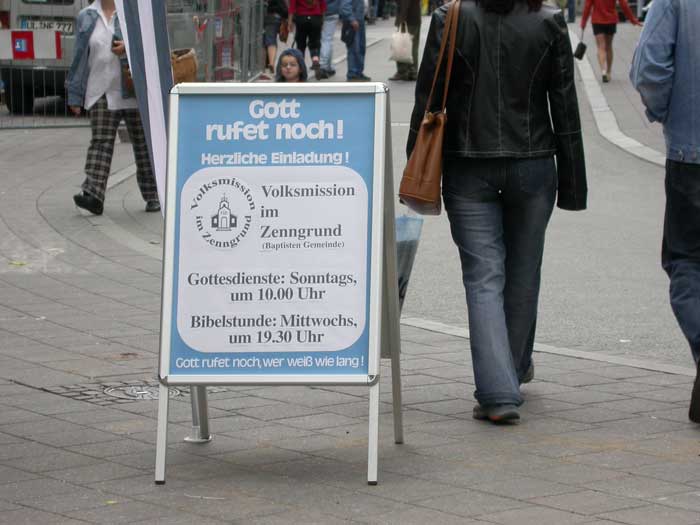
rufetw.jpg

Here’s a religious one, using the somewhat archaic rufet instead of ruft (God is calling), but incorporating a capitalization error (Sonntags/Mittwochs for sonntags/mittwochs) and a hyphenization one (Baptisten Gemeinde).

sonntw.jpg

Finally, this car sticker is directed against the extension of shop opening hours: Without Sunday there would only be weekdays (and vice versa, I imagine).

German lemon laws continued

Robin Stocks pointed out an article in the Stars and Stripes on this topic, entitled ‘German lemon law sweetens car purchases’.

bq. In January 2002, under a European Union directive on consumer protection, Germany changed its laws on tangible property sales to better protect the consumer. All German dealerships must provide a 12-month warranty for every used car they sell.

bq. Ensuring that a dealership provides the warranty will save the buyer a lot of heartache and legal hassles if a dream BMW or Mercedes turns out to be a lemon, said German lawyer Roland Schwengebecher, who is representing Pullum in his dispute with the car dealer.

(The client referred to is Lewis Pullum, presumably no relation to Geoffrey K. Pullum of Language Log).

bq. The German lemon law, Bürgeliches gesetz buch, para. 434ss, states that if a used car bought from a dealership is defective, the dealer must take the car back or pay for repairs. The law does not apply to private sellers.

It’s odd to see a section/paragraph of the Civil Code being referred to as ‘Germany’s lemon law’, even though it doesn’t deal specifically with cars. I also think the ss. should be ff. (or et seq.). Probably the reference should be to § 437 in conjunction with §§ 280 ff.

Leaving money to dogs/Tiere als “Erben”

Nicht mal in England kann man ein Tier zum Alleinerben machen, trotz deutschsprachiger Presseberichte. Salzburger Nachrichten:

bq. london (SN, dpa). Eine im Alter von 89 Jahren verstorbene Engländerin hat ihren beiden Hunden ein Millionenerbe hinterlassen. Laut “Daily Mail” vermachte Nora Hardwell den Collie-Mischlingen Tina und Kate ihr Vermögen in Höhe von 675.000 Euro. Außerdem haben sie alleiniges Wohnrecht in ihrem Haus mit weitläufigem Garten.

The Salzburger Nachrichten and other reported last week that an Englishwoman left her estate to two dogs.

They quoted the Daily Mail, but the report is not available online, at least no longer.

The Bath Chronicle has a slightly more detailed report:

bq. A Recluse has left a staggering £450,000 in her will to her two beloved dogs. Spinster Nora Hardwell earmarked more than half of her £800,000 estate to ensuring that rescue dogs Tina and Kate would be well cared for after her death.
Neighbours say she lived for the Collie Cross dogs, who now have the run of her house in a village near Bath.

Although the first sentence says she left the money to the dogs, the article makes it clear that £450,000 was set aside to pay for care for the dogs for as long as they live, including keeping her house run for them.

bq. Miss Hardwell’s last will and testament reads: “I give the sum of £450,000 to my executors on trust to invest it and to apply the income from it for the maintenance of any dog or dogs which I may own at my death for the period of 21 years from the date of my death or until the death of my last dog.”

bq. She said a home had to be kept and maintained for her dogs and carers employed to look after them.

bq. The residue of her estate – and any cash left at the end of the 21-year period – will go to the Cinnamon Trust, a national charity for the elderly and their pets; the Animal Health Trust, the Royal National Institute for the Blind and the Cancer Research Campaign.

Originally the testatrix had four dogs, but two died shortly after she did.

(Via Juristisches und Sonstiges)