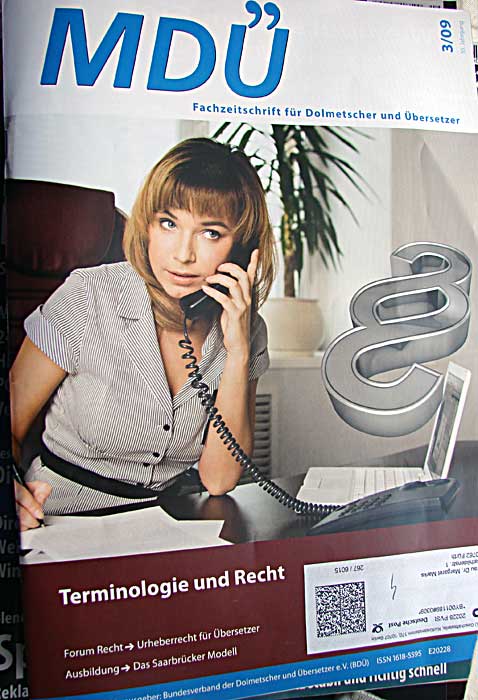
The MDÜ, the journal of the BDÜ. always takes one special topic, and the issue 3/09 takes terminology and law.
I hope I’m not too rude about it in coming entries. I mean, I don’t know any translators’ periodical that has good graphics:
No need to comment on the laptop with no number keypad and no second monitor attached, or the attack by the large shiny paragraph sign. These covers aren’t supposed to mean anything, just to add a bit of colour and interest.
I’ve read the three title articles and will come back to them. They are:
Demands on legal translators – about the difficulties of legal translation in general
Legal language in Germany, Sweden and England
Terminology, law and justice in South Africa
I’ll turn first to Barbara Kochhan’s review of the volume in the series German Law Accessible (nomen ist omen): Employment and Labor Law in Germany, by Lingemann, Steinau-Steinrück and Mengel, 2nd ed., price 98 euros.
I am particularly interested in this because I translate a fair amount of employment and labour law. This is a problem area when one is translating for Britain and the USA, because their employment law differs so greatly.
I also have a similar volume that I got last year: Labour Law and Industrial Relations in Germany, by Manfred Weiss and Marlene Schmidt, 4th ed., Wolters Kluwer, price 55 pounds at that time. Originally published as a monograph in the International Encyclopaedia of Laws/Labour Law and Industrial Relations. This book is well organized. It has a reasonable English index, but a German one would be excellent, as it gives the German terms in brackets. It’s in good English, but it reads a bit heavily, like a rather close translation.
I have seen other books in the series German Law Accessible, but not this one. The one I have on Family & Succession Law is in somewhat non-native English and its main use would be to compare terminology suggestions. These books written first in German and expounding German law, then translated into English, may be of some use for those who don’t speak German. For me, a comparative approach would be more useful, but it would have to compare the situation with that in England and Wales, or at least with the USA.
The review briefly describes the field and the structure of the book (94 pages general, 486 pages synoptic presentation of various legislation. It is critical of the lack of detail about the translator, Bedene Greenspan (Google indicates she translates in-house for a big law firm in Berlin). It comments on inconsistencies in spelling and translation.
I don’t agree with the reviewer on all the translations into English. I do agree that to use service agreement for Anstellungsvertrag and then contract of service is not a good idea. I would avoid the terms service and services altogether, because they are confusing – and service agreement can have a completely different meaning too. Contract of employment seems better.
But when it comes to criticizing the reference to Aktiengesellschaft as company (‘Company lässt an die limited liability company denken, um die es ja hier gerade nicht geht’), I can’t see the problem. Or at least, apparently the book is mainly in American English, and then there really is a problem. One could say corporation in American English, true.
Apparently the term Scheinselbständigkeit (a freelance does so much work for one client that it is effectively employment) is translated as pseudo-independence. The reviewer suggests pretended self-employment and bogus self-employment. Well, this is a tough term to judge a book on. I dislike all suggestions! I even recorded a long note by Beate Lutzebaeck, who is usually very good, on ProZ, who says that sham and bogus imply intent on the part of the person (right) and prefers fictitious self-employment (but to me that also suggests a construction selected by the person). I would say ostensible self-employment is the way to go. But it’s out of the news now, fortunately.
The reviewer concludes that the book might be of use to translators and interpreters, but is probably better for its intended readers, international lawyers, accountants and so on.