German-English contract book / Formularbuch Zivil-, Wirtschafts- und Unternehmensrecht Deutsch-Englisch

Link to amazon.de:
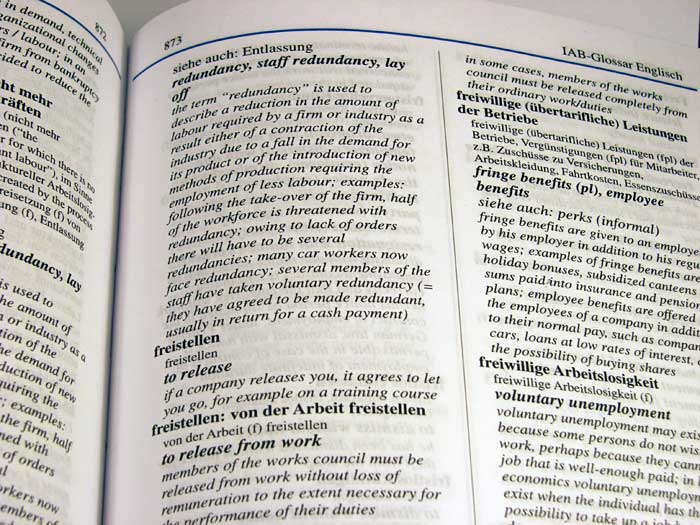
Beck’sches Formularbuch Zivil-, Wirtschafts- und Unternehmensrecht Deutsch-Englisch

The publisher says:

Das Buch bietet mehr als 150 kommentierte Verträge und kautelarjuristische Mustertexte zum deutschen Zivil-, Wirtschafts- und Unternehmensrecht, jeweils synoptisch in deutscher und englischer Sprache. Die Vorteile:

– Vertragsmuster auf Grundlage deutschen Rechts, die rechtssicher sowohl in englischer als auch in deutscher Sprache vereinbart werden können
– praxisbewährte zweisprachige Formulierungen mit ausführlichen rechtlichen Anmerkungen
– besonders wertvoll: umfassende Wortlisten für die Auswahl der treffenden Begriffe, einheitliche englische Terminologie innerhalb des Gesamtwerkes.

Man ist gespannt. Es kann nicht schlechter sein als ein paar andere solche Werke, die ich in den Händen hatte.

Translation difficulties in Turkish case / Übersetzungsprobleme bei Marco W.

Unter Fall Marco W.: Anwalt glaubt, man könne 170 Seiten in zwei Tagen übersetzen berichtet Richard Schneider, dass der Anwalt von Marco W. unrealistische Erwartungen an Übersetzern hat. Die schriftliche Aussage von Charlotte (übrigens spricht man diesen Namen mit Sch-, nicht Tsch- aus, Nachrichtensprecher!) liegt vor und umfasst 170 Seiten. Sie muss vor 14. Dezember ins Türkische übersetzt werden.

Marcos Anwalt Michael Nagel erklärte dazu in Hannover: „Das müsste in zwei Tagen machbar sein, wenn man entsprechende Dolmetscher hat.“

Branchenüblich ist eine Tagesleistung von 10 Seiten, wenn man eine Seite als 30 Zeilen à 55 Zeichen definiert. Zur Übersetzung des 170-seitigen Protokolls müssten also 17 Arbeitstage veranschlagt werden. Der Übersetzer muss sich bereits beeilen, um die Übersetzung bis zum 14. Dezember fertig zu stellen.

Man kann natürlich nicht wissen, wie eine Seite hier definiert wird. Bei Rechtsübersetzern wären 5 Seiten juristischer Text in einem normalen Tag üblich, aber in dringenden Fällen kann man vielleicht zehn Seiten übersetzen, allerdings braucht man eine Pause danach. Das sind aber meist dichte Texte. Eine Zeugenaussage geht meist etwas flotter. Ich sehe es aber genauso wie Richard. – Natürlich kann man mehrere Übersetzer nehmen, aber dann muss alles umso sorgfältiger überprüft werden, damit es einheitlich ist.

Aber diese Anwälte versichern uns ständig auf eine beunruhigende Weise, wie flott alles gehen wird.

FUSSNOTE DEUTSCH: Ich sollte auch beschreiben, was bei einem deutschen Gericht passieren würde. Es müsste eine beeidigte Übersetzerin beauftragt werden, die dann eigentlich alleine arbeiten müsste oder zumindest für die ganze Übersetzung geradestehen. Schon die Beauftragung würde einige Tage dauern. Mit einer Übersetzung bis 14. Dezember wäre nicht zu rechnen.

Marco W. is the 17-year-old German who has been in pre-trial (now during-trial) detention since May, when 13-year-old Charlotte from England accused him of sexual assault. His German lawyer thinks Charlotte’s 170-page statement can be translated into Turkish in two days.

The case seems practically unreported in Britain – most mentions are in forum discussions. One commenter says that Charlotte’s parents are divorcing and there is a custody battle. Here is some information from a Guardian/Observer commentary of October 38:

The case of ‘Marco’ is as big in Germany as ‘Madeleine’ is here. Yet we hear virtually nothing of it, even though the key to this mystery lies in Britain.

Marco Weiss, 17, has languished without trial since April in a Turkish prison cell crammed with 30 inmates after allegedly sexually assaulting a 13-year-old English girl, ‘Charlotte M’. And while his case will hardly tug at British heartstrings like the missing English child has, it shows how criminal cases can provoke international fissure.

It is alleged this apparently model German student survives on dirty water and one fleeting visit a week from his family. Defence lawyers blame the Manchester family for taking ages to produce a statement. The case has sparked fury, with a huge campaign to boycott Turkey and heavy lobbying from Chancellor Angela Merkel.

The start of the story is tawdrily familiar. Weiss claims he met ‘Charlotte’ at a dance on holiday in the Turkish resort of Antalya. He insists ‘Charlotte’ told him she was 15; he admits they kissed, but denies sexual assault. Germans claim the case is motivated more by the supposed devout Catholicism of Charlotte’s mother than by any crime.

Even more extraordinary rendition / US darf Briten entführen

The Times reports:

A senior lawyer for the American government has told the Court of Appeal in London that kidnapping foreign citizens is permissible under American law because the US Supreme Court has sanctioned it.

The admission will alarm the British business community after the case of the so-called NatWest Three, bankers who were extradited to America on fraud charges. More than a dozen other British executives, including senior managers at British Airways and BAE Systems, are under investigation by the US authorities and could face criminal charges in America.

Until now it was commonly assumed that US law permitted kidnapping only in the “extraordinary rendition” of terrorist suspects.

See earlier entry on extraordinary rendition.

(Via BoingBoing)

German-educated judges in Israel / Deutsche Richter in Israel

The Legal History Blog links to a paper (PDF) by Fanie Oz-Salzberger and Eli Salzberger on The Secret German Sources of the Israeli Supreme Court. Its main emphasis is on important Israeli judges who were educated in German-speaking Europe.

The present paper … offers a glimpse into the collective biography and intellectual legacy of a distinct group of German-born or German-educated jurists who came to Palestine during the 1930s following the rise of Nazism, reached key positions within the Israeli legal system, and became the founding fathers of the Supreme Court of Israel.

Most fascinating is the glimpse of a cosmopolitan German-speaking intellectual world with centres in Vienna, Krakow, Danzig, Heidelberg, Frankfurt-am-Main and Berlin. About 40 per cent of the lawyers in Frankfurt and Berlin were Jewish when Hitler came to power.

The German influence on the Israeli Supreme Court has not yet been an issue for discussion or research, despite the large number of judges born and/or educated in Germany. Nearly 50 percent of the Court’s first-generation judges were educated in German institutions. They were part of a mass migration that reluctantly left a beloved country and culture in the wake of the Nazi rise to power. They were immediately recognized in their new homeland as a group markedly different in accent and personality from the more numerous east-European immigrants. They even earned a collective nickname – “Yekkes”. This slang term, which is still alive, has been associated over the years with both positive and negative characteristics, from punctuality to excessive toughness.

The characteristics associated with the term Yekke (from German Jecke) seem to show some consistency over the years: see Wikipedia.

Thanks to Isabella Massardo, who sadly has closed her weblog Taccuino di traduzione, for the Legal History blog)