Woche der ausländischen Mitbürger

I know tomorrow is St. Jerome’s Day, and I know Monday was European Languages Day, but I only accidentally found out that this week is the Woche der ausländischen Mitbürger (Week of Foreign Fellow-Citizens).

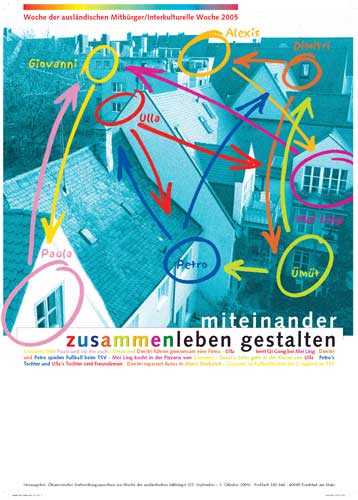
Plakat2005w.jpg

According to the poster, these are Giovanni, Ulla, Alexis, Dimitri, Paolo, Petro, Ümüt and Mei Ling, and most of them live in the top storeys (perhaps there are no Hinterhofgebäude where the poster was made).

There is something in Erlangen called ‘Ich muss etwas von dem Eigenen in mir bewahren – um dem unbekannten Anderen gegenüber offen zu sein’, with no further details. Nothing else local. But I think there’s more on the programme than for the European Day of Languages.

(Actually I discovered elsewhere that events in Nuremberg are merged with those for the International Human Rights Prize).

Computerised German law/TakeLaw-System

Amazing electronic developments in Wismar:

bq. Wenn am 2. November 2005 der Justizminister des Landes Mecklenburg-Vorpommern, Erwin Sellering, im modernen Technologiezentrum in Wismar das TakeLaw-System eröffnet, dann könnte für die Welt der Rechtswissenschaft ein neues Zeitalter anbrechen. … Es geht darum, die oft unverständliche Sprache der Juristen in eine computergenerierte graphische Darstellungsform zu übersetzen. Diese Kunstsprache ist für die Rechtswissenschaft mit einem Kunstherz in der Medizin vergleichbar: Es sorgt dafür, dass der juristische Gedanke auch dann am Leben bleibt, wenn der eigentliche Motor der Rechtswissenschaft – die Fachsprache –nicht mehr verständlich ist. Die erforderliche Software dafür, der TakeLaw-Editor, wird ab dem 2. November 2005 über das Internet für jedermann frei zur Verfügung stehen (www.TakeLaw.de).

I will have to see this to have any idea what it means. Apparently software (freely available to all after November 2 on a site that at present offers nothing) will convert legal language by computer into a graphic form. This is compared with an artificial heart, because legal ideas remain alive even when the ‘real engine of jurisprudence, legal jargon,’ is no longer comprehensible.

What is more, it will enable automatic marking of tests:

bq. Nunmehr wird es möglich sein, juristische Übungsklausuren computergesteuert zu korrigieren. Die Korrektur ist mit einer ausführlichen Besprechung sofort verfügbar. Dazu vergleicht das System das Ergebnis der abgegebenen Arbeit mit der erwarteten Lösung und erläutert es dem Studenten. Dabei werden ihm nicht nur seine Fehler aufgezeigt, sondern auch die richtige Lösung über Lautsprecher oder Kopfhörer mitgeteilt. Gleichzeitig erkennt das TakeLaw-System Wissenslücken und stellt entsprechende multimediale Vorlesungen über das Internet zur Verfügung. Diese werden derzeit in Wismar in einem Tonstudio von insgesamt 12 Rechtsdozenten aus 9 Universitäten produziert.

bq. It will now be possible to mark legal tests electronically. The corrected version will be available immediately with a detailed discussion. This is produced by the system comparing the test submitted with the correct solution and explaining it to the student. The student is not only shown the errors – the correct version is also given, by loudspeaker or headphones. The TakeLaw system at the same time spots gaps in knowledge and provides multi-media lectures via Internet. These are being recorded now by a total of 12 law lecturers from 9 universities at a studio in Wismar.

All this sounds almost as difficult as machine translation. I imagine they can do multiple-choice questions online, and then supplement gaps in the person’s knowledge as seen by the system. But how can they translate legal jargon into graphics?

(Via Handakte WebLAWg)

Prohibited degrees in Warrington / Schwiegermutter heiraten

BBC News reports

bq. The European Court of Human Rights earlier this month ruled the ban on marriage between people who were in-laws is a breach of human rights.
The decision came in a case brought by a man and his daughter-in-law.
Coincidentally, that couple were also from Warrington.

The Times still has an article on the Strasbourg case online.

bq. The court was told that a son from the woman’s first marriage now calls his own grandfather “Dad” and that the couple plans to adopt him. The man and woman went to the European Court of Human Rights after being refused permission to marry by the Superintendent Registrar at Warrington Register Office.

Private Acts of parliament have sometimes been passed, but the last was apparently in 1987. One assumes the law will be changed – there have occasionally been remarks suggesting it is pointless.

European Court of Human Rights, Case of B. and L. v. The United Kingdom

Extraordinary rendition

The World Wide Words newsletter, whose RSS feed I read, has chosen the term extraordinary rendition to comment on.

In US law rendition refers to the transfer of individuals by what is called extra-judicial process (kidnapping, in plain speech) from a foreign country to the USA to answer criminal charges. The defendant is said to have been rendered up to justice.
A problem for the security forces is that once brought to the USA the person is subject to US law and the rules of due process, which of course excludes torture. Hence extraordinary rendition, a euphemism for taking them to a country where these rules do not apply.
From the Independent, 1 Jul. 2005: One week ago a judge in Milan signed warrants for the arrest of 13 of the agents, which has thrown covert CIA activities outside the US under the spotlight and drawn attention to the increasingly common practice of so-called ‘extraordinary rendition’, by which the US seizes terror suspects and removes them to countries known for their use of torture.

Außergewöhnliche Auslieferung, I suppose. Here’s a German article of June 2005 using that term:

Italien: Erstmals geht Justiz in Europa gegen US-Praktiken des Kidnappings Verdächtiger vor. Klarnamen von Geheimdienstagenten an Mailänder Konsulat aufgedeckt

The terms Kidnapping and Verschleppung seem to be more common. See heise.de.
For rendition, Romain has ‘Überstellung von Straftätern (ohne förmliche Auslieferung)’.

Wikipedia has something about it too.